 Interview Kickstart

How the FDE Role Works in Product Companies (India Guide)
- At a product company, an FDE's job is to make the company's own product succeed inside a customer's systems, and to feed what they learn back to the product team.
- Product companies are funding FDE teams at scale in 2026: OpenAI ($4 billion), Microsoft ($2.5 billion, about 6,000 engineers), Anthropic ($1.5 billion), AWS ($1 billion) and Google Cloud ($750 million), per Analytics India Magazine.
- Of the 71 companies we grouped from Neurapath's October 2026 FDE tracker, 48 were product, tech or AI companies and 23 were IT services or consulting firms.
- TeamLease Digital and ADaSci put FDE pay in India at ₹9–12 LPA for entry level, ₹25–50 LPA mid-level and ₹50–80+ LPA for senior roles.
At a product company, a Forward Deployed Engineer (FDE) has one job: make the company’s own product work inside a customer’s real systems, then carry what they learn back to the people who build the product. You are part engineer, part consultant and part product scout, and you are judged on whether the customer actually gets value from the product, not on how much code you shipped.
That is different from the forward-deployed teams now forming at Indian IT services firms, and the difference matters for your career. This guide explains how the role works at product companies, who hires for it in India, what it pays and how to get in. If you are new to the term, start with what a Forward Deployed Engineer does.
Why product companies need FDEs at all
Complex products rarely “just plug in”. Palantir created the role because its software was too complex for customers to set up alone, so it sent engineers to sit with customers and configure the platform for them, according to Gregor Ojstersek’s Engineering Leadership newsletter. Palantir’s FDEs focus on enabling many capabilities for a single customer, rather than building one capability for many customers.
AI has made that gap wider. Analytics India Magazine reports that the usual blockers to enterprise AI are poor data quality, legacy systems, governance and workflow redesign, not the model itself. A product company can have the best model and still lose the deal if nobody connects it to the customer’s data.
So in 2026, product companies are building FDE organisations on a scale nobody expected, as Analytics India Magazine reported in July:
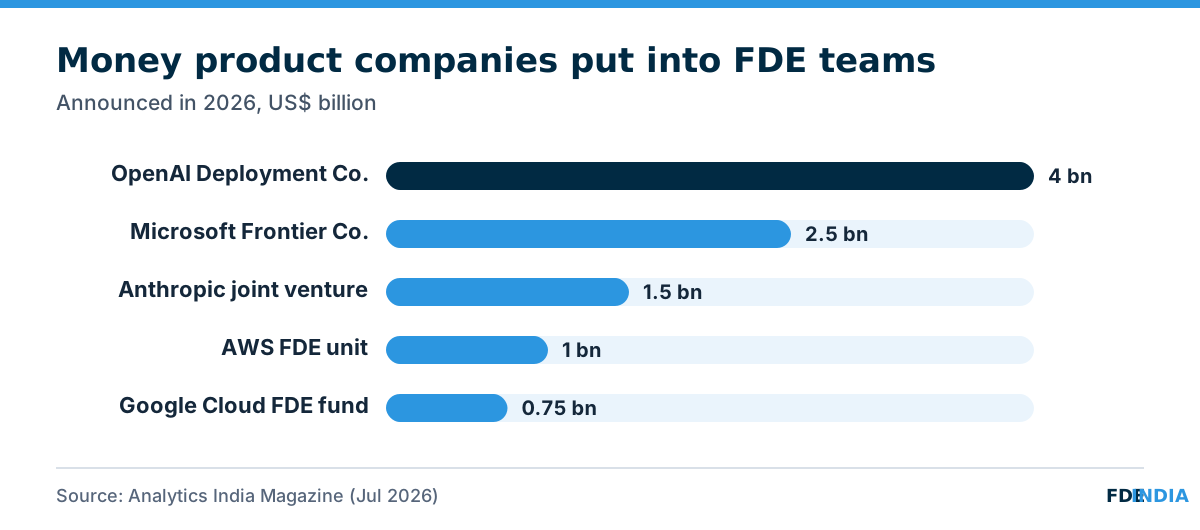 Announced 2026 commitments. Microsoft’s unit is staffed by about 6,000 engineers, per Analytics India Magazine.
Salesforce is moving the same way. Its UK solutions engineering head said at Dreamforce 2026 that the company would double its UK FDE capacity to about 95 engineers, ITPro reported, with FDE openings across Agentforce and Data 360.
How the role works: the product-company FDE loop
Most product-company FDE work follows the same loop, repeated with each customer.
- Scope the problem. Map the customer’s systems, data flows and goals, and agree on a use case tied to a business result. Salesforce describes the FDE’s purpose as helping customers “get value from technology faster”, per the Engineering Leadership newsletter, and its UK head said the aim is to build agents that “link directly to business value”.
- Build on the platform. Write the integrations, data pipelines, custom apps and AI workflows that make the product fit. Databricks’s Bengaluru listing describes building and productionising customer data and AI solutions on its platform, including reference architectures and model integration.
- Deploy and stabilise. Take it to production inside the customer’s environment, with their security and engineering teams. OpenAI’s FDE role includes deploying models on customer infrastructure, according to the same newsletter.
- Feed the product. Send what broke, what was missing and what customers asked for back to engineering. Databricks says its FDEs give product feedback to engineering and support, and that the work can “influence the Databricks product roadmap”. Internal Salesforce FDEs test features in live customer environments to help improve the product.
- Make it reusable. Turn one customer’s solution into accelerators, templates and best practices the next FDE can use. Databricks lists creating reusable accelerators and frameworks as part of the job.
Step 4 is what separates a product-company FDE from a consultant. PostHog describes how OpenAI’s FDEs worked with a call-centre automation customer, built evaluations, and fed the findings to the research team; the improvements later shipped in OpenAI’s Realtime API. Constellation Research’s Holger Mueller makes the same point in Analytics India Magazine: consultants can only customise and extend a product, while FDEs can finish the product during an engagement and feed learnings back into development.
Product company vs IT services: how the FDE job differs
Indian IT firms are building forward-deployed teams too. TCS plans to move at least 1% of its employees into a new operating model built on small, multi-skilled squads, and its COO said the approach differs from the one popularised by AI-native software firms, per Analytics India Magazine. Here is how the two compare:
| FDE at a product company | Forward-deployed team at an IT services firm | |
|---|---|---|
| What you deploy | Your own company’s platform (Databricks, Salesforce, OpenAI models…) | Whatever mix of vendors’ tools the client uses |
| Why the role exists | Drive adoption and usage of the product; prove it works in real settings | Solve a specific client problem, often under a contract |
| Feedback loop | Direct line to the product and engineering teams | Mostly to the client and the delivery team |
| Typical scope | Close to the model: solution design, strategic use cases | Large-scale integration, governance, managed operations |
| Travel and customer time | High; Databricks lists about 20% travel | Varies by client and project |
Gartner’s Arun Chandrasekaran expects AI vendors to keep the high-value work close to the model, while system integrators handle large transformation, integration and managed operations, according to Analytics India Magazine. Neither path is “better”. They build different muscles: product depth and roadmap influence on one side, multi-vendor delivery and domain breadth on the other.
Who hires product-company FDEs in India
Product, tech and AI companies make up most of the employers listing FDE roles in India. We grouped the companies listed on Neurapath’s FDE jobs tracker in October 2026 by employer type:
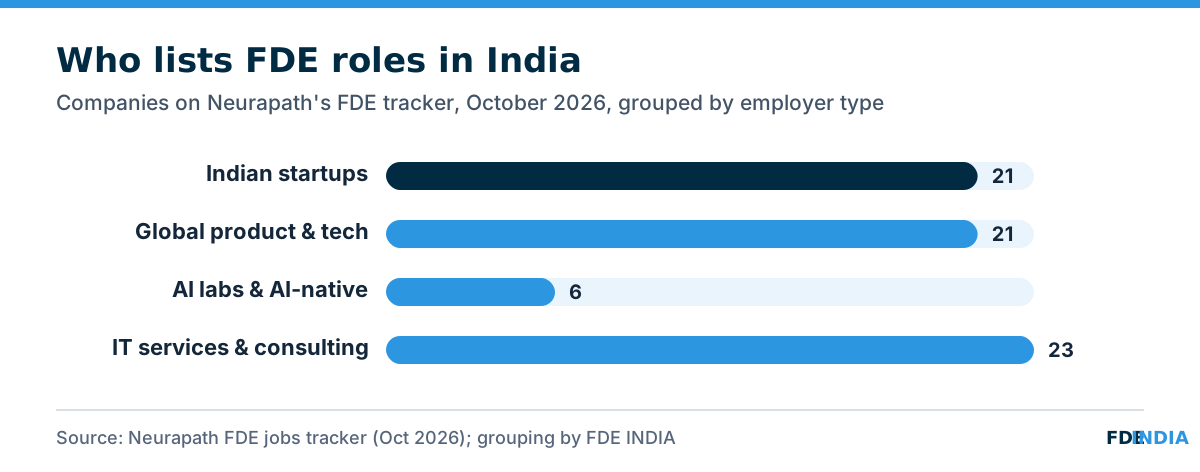 71 companies grouped by FDE INDIA from Neurapath’s October 2026 tracker. Some listings are “related” roles rather than FDE-titled.
Examples from the tracker, with the cities listed:
- Global product and platform companies: Databricks (Bengaluru, Mumbai, remote), Google (Bengaluru), MongoDB (Gurugram), Notion (Hyderabad, remote), DevRev (Delhi/Noida, Mumbai, Chennai, Bengaluru), HighRadius (Hyderabad, entry to senior), Adobe (Noida).
- AI labs and AI-native companies: Cursor (Bengaluru, Mumbai, Delhi, remote), OpenAI (related roles in Bengaluru, Mumbai, Delhi), Sarvam AI (related role in Bengaluru), Blitzy.
- Indian startups: Prodigal (Mumbai, Bengaluru), Composio (Bengaluru), Vishleshan AI (Mumbai), Cyble (Bengaluru) and others.
Listings change weekly, so treat these as a starting list and check each company’s careers page. Our FDE Pulse tracks new openings three times a week.
What product companies expect you to own (KRAs)
Product-company listings rarely publish hard KPIs. Databricks’s senior FDE listing names none, but it stresses “measurable outcomes” and customers’ “successful understanding, evaluation and adoption” of the platform. Reading across the listings and company statements above, the recurring areas of ownership are:
- Customer adoption: the customer actually uses the product in production, not just in a pilot.
- Time to value: how fast the customer gets a working result (Salesforce’s “get value from technology faster”).
- Delivery against scope: Databricks asks for experience managing scope, timelines and measurable outcomes.
- Product feedback: clear, repeatable issues and feature requests passed to engineering.
- Reusable assets: accelerators and patterns other teams can reuse.
The requirements are demanding. Databricks’s senior role in Bengaluru asks for 6+ years in data engineering, AI or analytics, Python, Scala or TypeScript, working knowledge of two or more clouds, deep Apache Spark experience, CI/CD and a Databricks certification. For a full breakdown, see the key skills of an FDE and how much experience you need.
What product-company FDEs earn in India
TeamLease Digital and ADaSci, cited by Analytics India Magazine, put FDE packages in India at:
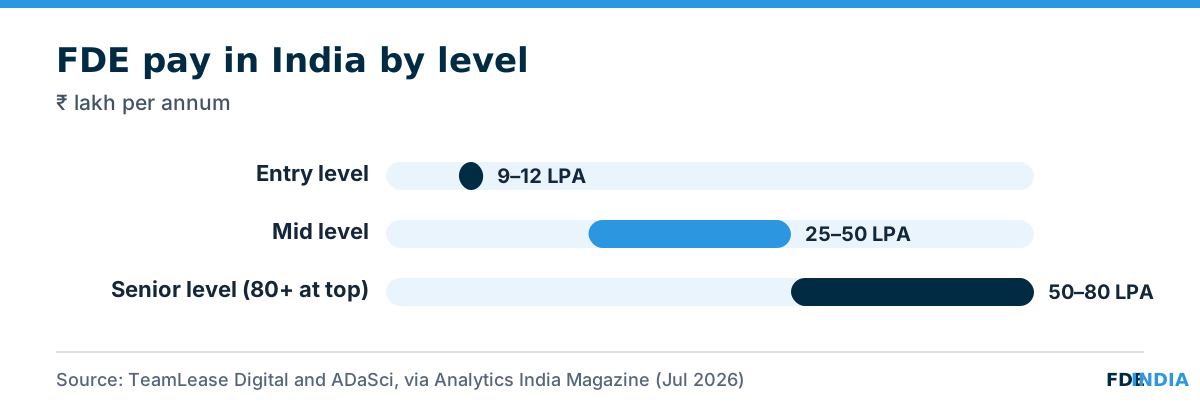 Across employer types, not product companies alone. Source: TeamLease Digital and ADaSci via Analytics India Magazine.
These bands cover all employers. Employer-posted listings reviewed by fde.directory in July 2026 showed global platform companies’ India centres at about ₹22–55 LPA and funded AI startups at about ₹25–90 LPA, compared with roughly ₹5–30 LPA at consulting and IT services firms. Product roles tend to sit in the upper bands, but only employer-posted figures tell you what a specific role pays.
How to move into a product-company FDE role
- Pick a platform and go deep. Product companies hire for their own stack. If you target Databricks, learn Spark and get certified; if you target Salesforce, learn Agentforce and Data Cloud.
- Build one deployed project on that platform. Connect it to a messy, real data source, ship it, and write up what broke and how you fixed it. That write-up is your best interview story.
- Practise the feedback habit. For every project, note three things the product should do better. Interviewers at product companies look for engineers who think about the product, not just the ticket.
- Show customer-facing proof. Demos, client calls, on-call ownership or internal “customer” teams all count. Put them on your resume with outcomes.
- Target the right level. Mid-level (2–5 years) listings are the most common on Neurapath’s tracker; senior platform roles like Databricks’s ask for 6+ years.
- Check your gaps before applying. The FDE Alignment Checker scores your resume across the six skill areas employers ask for and shows the roles you are closest to.
See typical Forward Deployed Engineer pay for your experience, company type and city, next to real employer-posted pay.
Frequently asked questions
What is the difference between an FDE at a product company and at an IT services company?
At a product company, the FDE deploys the company's own platform and feeds customer learnings back into that product. At an IT services firm, forward-deployed teams solve specific client problems across many vendors' tools, usually under a client contract. Analysts quoted by Analytics India Magazine expect AI vendors to keep work close to the model, while system integrators handle large-scale integration and managed operations.
Do FDEs at product companies write production code?
Yes. Databricks's Bengaluru FDE listing asks for production data and AI architectures, coding in Python, Scala or TypeScript, and CI/CD experience, and descriptions of OpenAI's FDE role mention building full-stack solutions and production AI systems.
Which product companies hire FDEs in India?
Neurapath's October 2026 tracker lists FDE or related roles in India at companies including Databricks, Google, Cursor, OpenAI, Notion, MongoDB, DevRev, HighRadius, Adobe and Sarvam AI, plus many Indian startups. Check each company's careers page for current openings.
How much experience do product companies ask for in FDE roles?
It varies by level. Databricks's senior FDE role in Bengaluru asks for 6+ years, while HighRadius lists entry, mid and senior FDE roles in Hyderabad. Most product-company listings on Neurapath's tracker are tagged mid (2–5 years) or senior (5+ years).
Get FDE Pulse in your inbox
New FDE jobs in India, who's hiring, pay in LPA and the week's guides, in one short email. Unsubscribe in one click.
Check your inbox for a welcome email from [email protected]. Your first FDE Pulse arrives on Sunday.
Sources
- Senior Forward Deployed Engineer (Bengaluru) — Databricks Careers, Oct 2026
- Why Big Tech is Spending Billions on Forward Deployed Engineers — Analytics India Magazine, Jul 2026
- Forward Deployed Engineers are Testing Indian IT, Not Replacing It — Analytics India Magazine, Jul 2026
- Salesforce doubles down on forward deployed engineers in UK Agentforce push — ITPro, Sep 2026
- Should you become a Forward Deployed Engineer? — Engineering Leadership (Gregor Ojstersek), Apr 2026
- WTF is a forward deployed engineer? (and why everyone is hiring them) — PostHog, Feb 2026
- Forward Deployed Engineer Jobs in India — Neurapath, Oct 2026
- Forward Deployed Engineer Jobs in India: The 2026 Market — fde.directory, Jul 2026