 Interview Kickstart

Forward Deployed Engineer Interview Questions (and How to Answer)
- FDE interviews usually test five things: practical coding, fitting a product into a customer's existing systems, LLM and agent design, decomposing a vague business problem, and handling customers.
- techinterview.org reports that only about four in ten candidates clear the 45-minute decomposition round, and that it carries more weight than any coding screen.
- Indian FDE listings tell you what will be tested: Razorpay asks for reading unfamiliar code, APIs, webhooks and agent evals; Sarvam AI asks applicants to complete an AI agent assignment before interviews.
- Reported processes take about 3–5 weeks at OpenAI and 3–4 weeks at Palantir, per techinterview.org, while one DevRev candidate in New Delhi described a one-week, one-round process on Glassdoor.
Forward Deployed Engineer (FDE) interviews ask a mix of practical coding, integration design, LLM and agent questions, open-ended business problems and customer scenarios. The coding is rarely harder than a normal software engineering loop. What catches people out is the rest: breaking down a vague customer problem out loud, and showing you can be trusted in front of a client.
This guide collects real and representative FDE interview questions by round, drawn from Glassdoor candidate reports, company-specific guides and Indian job listings, and explains what a strong answer shows for each. If you are still deciding whether the role suits you, start with what the FDE role involves.
How the FDE interview is structured
No two companies run the same loop, but the pattern is consistent. A guide on techinterview.org (updated August 2026) describes five round types: decomposition, learning, coding, re-engineering (debugging) and system design, with 15–20 minutes of behavioural questions folded into nearly every round. It says Palantir’s onsite is three 60-minute rounds drawn from that pool, and that the FDE loop weights coding, customer-facing scoping and reasoning under ambiguity roughly equally.
A Palantir candidate writing on PracHub in September 2026 described the same shape: a recruiter screen, a decomposition round, an onsite of coding, learning and decomposition, and a final hiring-manager round.
For Google’s FDE roles, Scaler’s guide (updated October 2026) describes a reported, not official, four-part loop: a recruiter screen on role fit, practical coding, system design focused on fitting Google products into a customer’s existing systems, and customer-facing behavioural rounds.
Indian companies often run shorter loops. One candidate who interviewed for DevRev’s FDE role in New Delhi reported on Glassdoor in May 2026 that the process took a week and had a single role-alignment round with an engineer, covering past experience, expected skills and day-to-day scenarios.
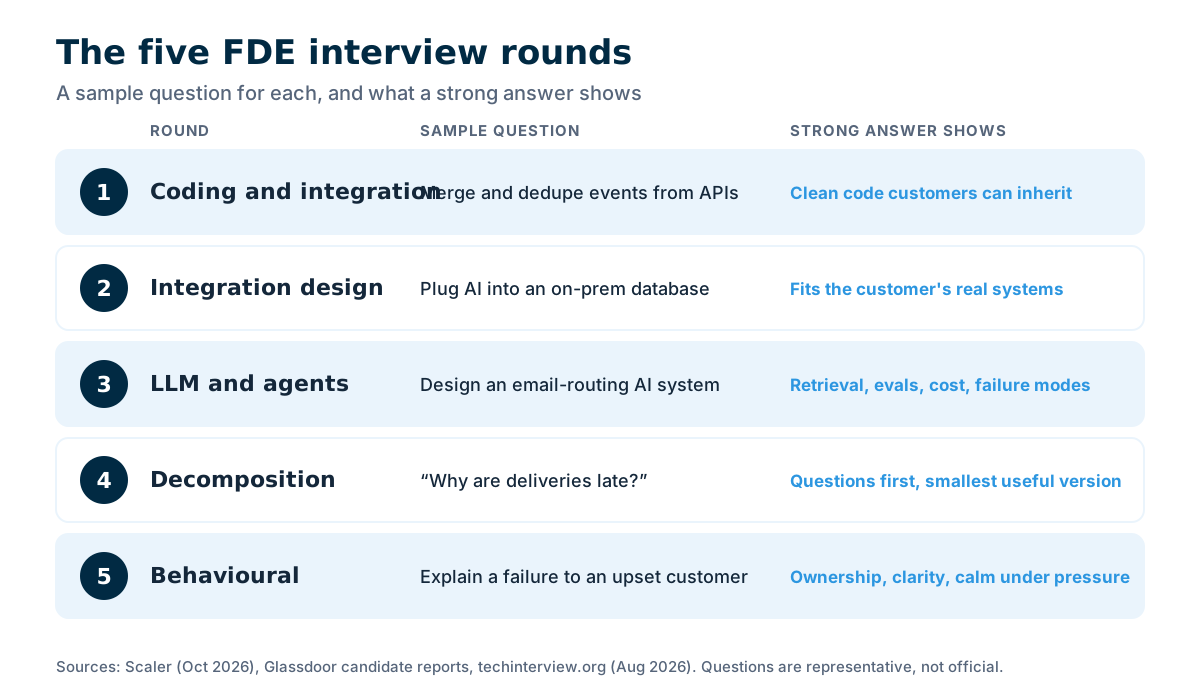 The five round types you are most likely to meet. Sample questions from Scaler (Oct 2026), Glassdoor and techinterview.org (Aug 2026).
The table below maps each round to what it is really testing.
| Round | What it looks like | What it tests |
|---|---|---|
| Coding and integration | Practical data or API problem, sometimes a LeetCode-style screen | Clean, readable code that solves the user’s problem |
| Integration design | Fit a product into a customer’s existing, messy systems | Trade-offs, security, migration risk |
| LLM and agents | Design a RAG pipeline or agent workflow | Retrieval, evaluation, cost and failure handling |
| Decomposition | A vague business problem with no clear answer | Scoping, questioning, prioritising |
| Customer and behavioural | Stories about difficult clients and changing requirements | Ownership, communication, judgement |
Round 1: Coding and integration questions
Expect problems that look like real customer data work rather than puzzles. Scaler lists these representative coding questions for Google’s FDE loop:
- Normalise and deduplicate customer events arriving from several APIs with different schemas.
- Build a pipeline that moves data from a customer’s legacy database into BigQuery and handles schema mismatches.
- Find the top 10 most-used features per user segment from access logs.
Classic screens still appear. Candidates on Glassdoor report “group anagrams” and “longest unique substring” in FDE phone screens, and a 2025 Glassdoor review of DevRev’s FDE interview lists merge intervals and a rate limiter function. Other candidate-shared questions include finding a row-count discrepancy between four files and a backup, and SQL to select records where the same category appears three times in a row.
What a strong answer shows: you clarify the input format before coding, handle bad data (nulls, duplicate IDs, schema drift) explicitly, and write code a customer’s team could maintain after you leave. Name your functions well and say out loud what you would log in production.
Some loops add a debugging round. techinterview.org describes it as unfamiliar code with stated expected behaviour where you find and fix the bugs; it says strong candidates reproduce the failure, form a hypothesis, isolate the cause and verify the fix, while random line changes read poorly.
Round 2: Integration and system design questions
This is not greenfield system design. You are designing into a customer’s existing world. Scaler’s representative Google FDE questions:
- Deploy demand forecasting on Vertex AI when the customer’s data sits in an on-prem Oracle database with no cloud connectivity.
- Design a HIPAA-compliant data flow and access controls for patient data.
- Plan a minimal-disruption migration of a customer’s ETL pipeline from another cloud.
Indian listings point the same way. Razorpay’s Bengaluru FDE listing asks for grounding in APIs, webhooks, authentication, data pipelines, logs and production systems, and says the FDE owns merchant integrations from architecture to go-live. Google Cloud’s generative AI FDE listing for Bengaluru (posted June 2026, now closed) describes building the integration layer between Google’s AI products and customer infrastructure, including legacy data sources and security boundaries.
What a strong answer shows: you ask what already exists and what cannot change, start with the smallest integration that delivers value, and plan for rollback, data security and who operates the system after go-live. For Indian clients, mentioning data residency and approval flows in regulated sectors such as payments and banking is a natural fit.
Round 3: LLM, RAG and agent questions
Most new FDE roles involve generative AI, so expect at least one design discussion on it. Questions shared by candidates on Glassdoor include:
- Walk through a full flow design of an LLM RAG architecture.
- Design an AI system that handles incoming emails and routes them to the right teams.
Job descriptions tell you how deep to go. Razorpay asks for hands-on experience with frameworks such as LangChain, LangGraph, AutoGen or MCP, and describes building agent workflows with tool bindings, evals and human approval steps. Google Cloud’s listing mentions evaluation pipelines that test accuracy, safety and latency, and LLM metrics such as cost per request. Sarvam AI’s Forward Deployed Software Engineer listing (1–3 years, Bengaluru) asks for prompt engineering, vector databases and semantic search, and requires a completed AI agent assignment with the application.
What a strong answer shows: a clear pipeline (ingest, chunk, embed, retrieve, generate), plus the parts weaker candidates skip: how you build an evaluation set, how you catch wrong or unsafe answers, when a human approves an action, and what each request costs. If you submitted a take-home agent, be ready to defend every design choice in it. Our FDE skills guide covers how to build these skills.
Round 4: Decomposition and customer-scenario questions
This round decides most loops. techinterview.org says the roughly 45-minute decomposition round carries more weight than any coding screen and that only about four in ten candidates clear it. Its example prompts:
- A logistics company wants to know why deliveries are late. Where do you start?
- A hospital has patient records in six systems that don’t talk to each other.
- A customer says their dashboard is wrong but cannot tell you which number.
What a strong answer shows: according to techinterview.org, strong candidates spend the first ten minutes asking about users, data freshness and what “done” means, then propose the smallest version that delivers value. Weak answers jump straight to databases and architecture. A useful structure: restate the goal, ask five or six sharp questions, list hypotheses, pick the cheapest test, and say what you would show the customer at the end of week one.
For an Indian twist, practise with local scenarios: a logistics firm in Pune with late deliveries, a bank in Mumbai whose loan-approval dashboard disagrees with its core system, or a D2C brand whose support tickets doubled after a sale.
Round 5: Behavioural and customer-facing questions
Scaler’s representative behavioural questions for Google’s FDE loop:
- Describe a time you explained a technical failure to an upset customer.
- Describe how you adapted when requirements changed mid-project.
- Describe a disagreement with a customer about their technical approach.
Screens also probe motivation. A PostHog FDE candidate reported on Glassdoor India in May 2026 that the recruiter screen focused on past experience and why they wanted to join. Razorpay’s listing asks for direct experience running discovery calls with external technical teams and managing ambiguity, so expect questions on exactly that.
What a strong answer shows: a specific situation, what you personally did, a measurable result and what you would change. FDE interviewers listen for ownership. “The client’s team was slow” is a weak story; “I set up a daily 15-minute call and unblocked the API keys in two days” is a strong one.
How long the FDE interview process takes
techinterview.org puts the process at about three to four weeks at Palantir and three to five weeks at OpenAI. Indian startups can move faster: the DevRev candidate in New Delhi described a one-week process. Decisions can also drag; the Palantir candidate on PracHub waited about five weeks for a final answer.
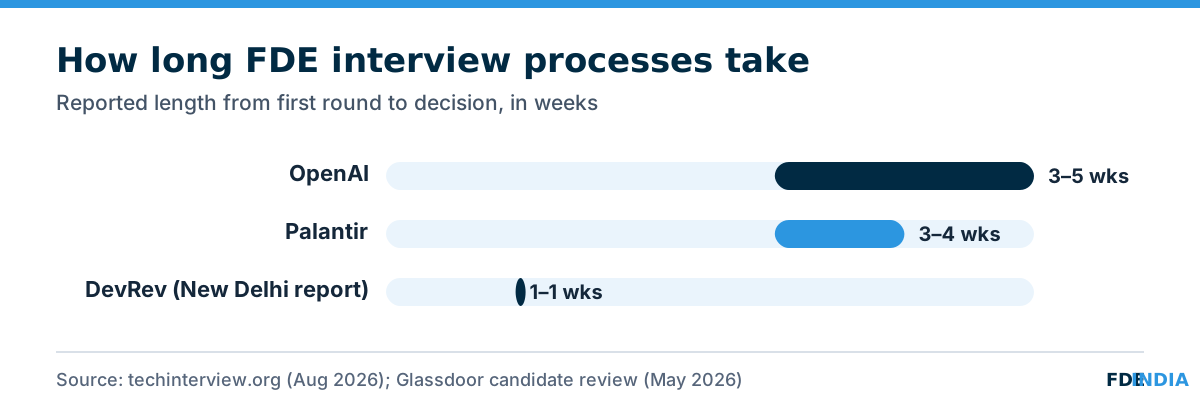 Plan for a month at global AI companies. Sources: techinterview.org (Aug 2026); one Glassdoor candidate review (May 2026).
How to prepare for FDE interview questions: a step-by-step plan
- Turn the job description into questions. Take each line of the listing and write the question it implies. Razorpay’s line about reading unfamiliar code quickly becomes “debug this repo in 30 minutes”; its line on webhooks becomes “design idempotent webhook handling”.
- Practise 10 data-wrangling problems. Merging inconsistent JSON from two APIs, deduplicating events and SQL window functions cover most coding rounds. Do a handful of classic medium-level problems too, since some screens still use them.
- Build one small agent with an evaluation set. For example, an email router with 30 labelled test emails, measured accuracy and cost per request. This prepares you for both the LLM round and take-home assignments like Sarvam AI’s.
- Run decomposition drills out loud. Set a 45-minute timer, take a vague prompt such as “deliveries are late”, and force yourself to ask questions for the first ten minutes before proposing anything. Record yourself and review it.
- Prepare five customer stories. Cover a failure you explained, a scope change, a disagreement, a fast unblock and a time you said no. Add a number to each.
- Match your level. Listings in India range from Sarvam AI’s 1–3 years to Razorpay’s 3–10 years; senior roles such as Databricks’s Senior FDE in Bengaluru (listed on Indeed India) will push harder on design and client leadership. Our guide to FDE experience requirements breaks this down.
Not sure which of these areas is your weakest? The FDE Alignment Checker maps your profile against what Indian employers ask for. For company-specific detail, see our pages on the FDE role at Google, Razorpay and Sarvam AI.
For six weeks of structured practice on these rounds, including 15 mock interviews, see the Interview Kickstart FDE course.
Learn what Forward Deployed Engineer roles need, how companies hire for them and how to build a plan to close your gaps, with Interview Kickstart.
 Powered by Interview Kickstart
Frequently asked questions
What questions are asked in a forward deployed engineer interview?
Expect practical coding (cleaning and merging data from several APIs), integration design (connecting a product to a customer's legacy systems), LLM questions such as designing a RAG or email-routing system, a vague business problem to break down, and behavioural questions about difficult customers. Glassdoor carries hundreds of candidate-shared FDE questions across companies.
Is the FDE interview harder than a software engineer interview?
The coding is usually no harder, but the loop adds rounds that most engineers have not practised: decomposing an open-ended customer problem and handling customer scenarios. techinterview.org reports that only about four in ten candidates clear the decomposition round.
Do Indian companies ask LeetCode questions for FDE roles?
Some do. A Glassdoor review of DevRev's FDE interview lists merge intervals and a rate limiter, and other candidates on Glassdoor report group anagrams and longest unique substring in phone screens. Most loops then move to integration, data and customer-facing problems.
How should I prepare for an FDE interview in India?
Read the job description line by line and turn each requirement into a practice question, build one small agent with an evaluation set, practise decomposition prompts out loud, and prepare four or five customer stories with numbers. The step-by-step plan in this guide covers each.
Get FDE Pulse in your inbox
New FDE jobs in India, who's hiring, pay in LPA and the week's guides, in one short email. Unsubscribe in one click.
Check your inbox for a welcome email from [email protected]. Your first FDE Pulse arrives on Sunday.
Sources
- What the forward deployed engineer interview really tests — techinterview.org, Aug 2026
- Google Forward Deployed Engineer: Role, Interview & Salary Guide — Scaler, Oct 2026
- Forward Deployed Engineer Interview Questions — Glassdoor, Oct 2026
- DevRev Forward Deployed Engineer interview reviews — Glassdoor, May 2026
- PostHog Forward Deployed Engineer interview review — Glassdoor India, May 2026
- Palantir Forward-Deployed Engineer interview: decomposition and onsite loop — PracHub, Sep 2026
- Forward Deployed Engineer (Bengaluru) — Razorpay Careers, Oct 2026
- Forward Deployed Software Engineer (Bengaluru) — Sarvam AI Careers, Oct 2026
- Forward Deployed Engineer, Generative AI, Google Cloud (Bengaluru) — Talentmate, Jun 2026
- Databricks Forward Deployed Engineer jobs — Indeed India, Oct 2026