 Interview Kickstart

Backend Engineer to Forward Deployed Engineer: A 90-Day Switch Plan
- Backend work already covers most of an FDE job description: FDE Academy estimates APIs, databases, observability, cloud and CI/CD make up roughly 60–70% of it.
- The gaps are customer-facing communication, production LLM work (RAG, evals) and scoping problems with no spec, which a focused 90-day plan can start to close.
- India FDE-family listings mostly ask for 2–6 years of experience; MongoDB's Gurugram FDE role asks for 5+ years of backend engineering, according to Masai School's October 2026 review of careers pages.
- Reported India FDE pay varies widely: Levels.fyi shows a median total compensation of about ₹17.7 LPA from 12 salaries in November 2026, while Indeed India's posted base averages about ₹12 lakh.
If you are a backend or data engineer in India, you are already closer to a Forward Deployed Engineer (FDE) role than almost anyone else. Most of the technical work transfers. What changes is how you work: directly with customers, on problems that arrive without a spec, increasingly with LLMs in the stack. With 2–5 years of production experience and a focused 90 days, the switch is realistic.
Demand is there to support the move. FDE job postings on Indeed in India rose nearly 19-fold year on year in June 2026, according to an Indeed report covered by PTI via People Matters in October 2026. The roles are spread across Bengaluru, Hyderabad, Chennai, New Delhi, Mumbai and remote, in tech companies, consulting firms, startups and AI specialists. Indeed did not publish absolute posting counts, so the starting base may be small.
What transfers from backend engineering to FDE work
FDE Academy estimates that core backend skills cover roughly 60–70% of an FDE job description (June 2026). Those skills are:
- API design and integration: REST, GraphQL, auth, rate limits, idempotency.
- Data modelling: SQL and NoSQL schemas, query performance, migrations.
- Observability and debugging: logs, metrics and traces on systems you did not build.
- Cloud and infrastructure: AWS, GCP or Azure.
- Testing and CI/CD: pipelines, deployment gates, rollbacks.
India listings confirm this. OneByZero’s Bengaluru FDE posting (May 2026, 2–5 years) asks for backend or full-stack development in Java, Python, Node.js or Go, AWS, REST APIs, databases, distributed systems, Git, CI/CD and containers, plus practical GenAI knowledge such as RAG. MongoDB’s FDE role in Gurugram asks for 5+ years of backend engineering, according to Masai School’s review of careers pages on 30 October 2026.
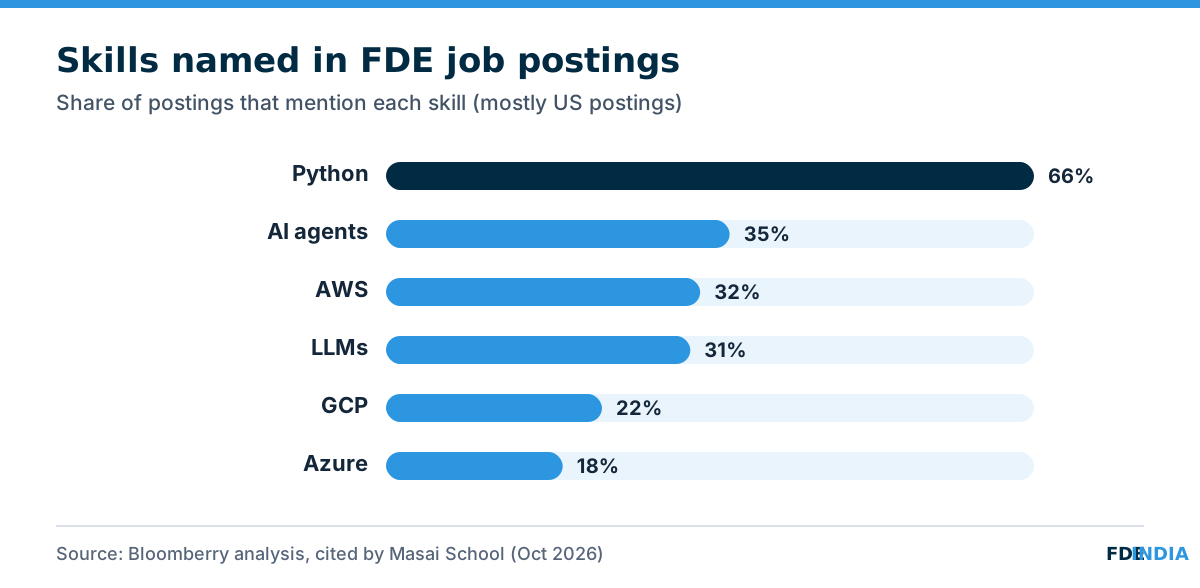 Python and cloud dominate FDE postings. The data comes mostly from US postings (Bloomberry, cited by Masai School, October 2026).
The language signal is clear. In Bloomberry’s posting analysis, cited by Masai School, Python appears in 66% of FDE postings, AI agents in 35% and LLM experience in 31%. Among the clouds, AWS appears in 32%, GCP in 22% and Azure in 18%. If you work in Java or Go, keep using it, but get comfortable writing production Python as well.
The gaps backend engineers need to close
Both Scaler guides (August and October 2026) and FDE Academy list much the same gaps:
| Gap | What it looks like in the job | How to practise it from a backend role |
|---|---|---|
| Customer-facing communication | Explaining trade-offs to non-engineers, running demos, saying no politely | Volunteer for escalations, sit in on client or sales calls, run internal demos |
| Production LLM skills | RAG pipelines, evals, handling hallucinations, prompt versioning, latency | Ship one LLM feature end to end and measure it |
| Scoping with no spec | No ticket, unclear owner, undocumented legacy systems | Write scope, stakeholders, data sources, constraints and success metrics before coding |
| Outcome ownership | Owning whether the customer got value, not just whether the endpoint works | Track the business metric your service moves |
| Deploying in someone else’s environment | Customer VPCs, restricted networks, their cloud account | Deploy your project into a fresh account with least-privilege access |
The first row is the hardest for most backend engineers. FDE interviews often include a client-simulation round and an open-ended “deployment problem” round, according to FDE Academy. Pure coding preparation will not cover these. For question-level preparation, see our FDE interview questions guide.
How much experience India FDE listings ask for
Most FDE-family roles in India want engineers who have already shipped production systems. That works in favour of mid-level backend engineers.
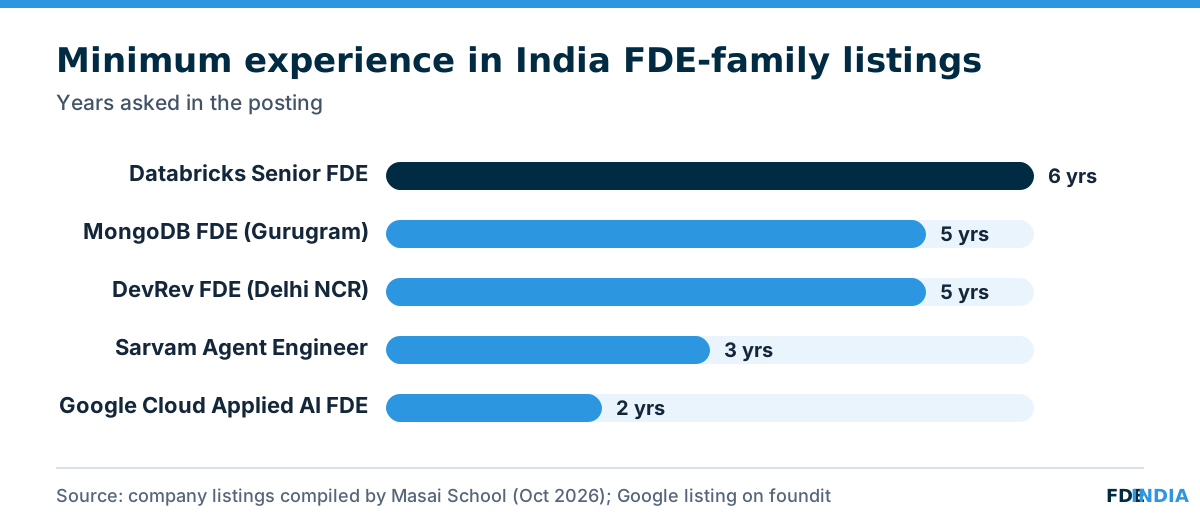 Most listings want 2–6 years. Sources: careers pages compiled by Masai School (October 2026); Google’s listing on foundit.
Masai School’s October 2026 reviews put Databricks’ Senior FDE role in Bengaluru at 6+ years, DevRev’s FDE role in Delhi NCR at 5+ years with mostly customer-facing work, and Sarvam’s Agent Engineer role at 3+ years. Sarvam’s posting says shipping something real users depended on matters more than years. Google’s Cloud Applied AI FDE listing in Bengaluru, now closed, asked for 2 years of software development and hands-on GenAI experience, according to foundit. For the full picture by employer type, see how much experience an FDE needs in India.
One more useful signal: Salesforce says 40–50% of its FDE movement is internal, according to Masai School. If your employer is building a deployment or AI services team, an internal move may be your fastest route.
The 90-day plan: backend engineer to FDE
This plan assumes about 10–15 hours a week alongside a full-time job. Scaler’s software engineer guide uses a similar 30/60/90-day split. FDE Academy suggests 6–12 months at 8–12 hours a week, so treat 90 days as the point where you start applying, not the point where you’re finished.
Days 1–30: learn the LLM layer on top of your backend skills
- Build a RAG service the way you would build any production API. Add chunking, embeddings, a vector store, retrieval, auth, rate limits and logging.
- Write evaluations. Create a test set of 30–50 questions with expected answers and track accuracy each time you change prompts or retrieval.
- Practise integration design. For three realistic client systems (an ERP, a CRM, a ticketing tool), sketch how you would connect an AI feature, including failure modes and data access.
Days 31–60: ship one deployment-style portfolio project
- Pick an enterprise-shaped problem. FDE Academy suggests document Q&A for a legal team, a support-triage agent or an invoice-extraction pipeline. Use messy, realistic data.
- Deploy it somewhere you don’t control by default. Use a fresh cloud account with least-privilege IAM, environment-based config and a one-command setup.
- Get one real user. A friend’s small business, an internal team or an open-source community will do. Fix what they report, and write a short postmortem on what broke and how you measured the improvement.
Days 61–90: reposition and apply
- Rewrite your resume around outcomes and stakeholders. Change “Built payments reconciliation API” to something like “Deployed a reconciliation service with the finance team that cut manual dispute checks”. Both Scaler guides recommend this shift from features to customer outcomes.
- Run mock rounds. Practise one open deployment problem and one client simulation each week, out loud and timed.
- Apply in two lanes. Apply internally to deployment-adjacent work, and externally to FDE, Applied AI Engineer and Forward Deployed / Implementation Engineer titles. Our guide to roles similar to FDE lists the adjacent titles worth searching. Before you apply, the FDE Alignment Checker can show which skills in your profile still look thin.
What the switch can pay
Pay data for FDEs in India is thin and inconsistent, so treat every number as a range.
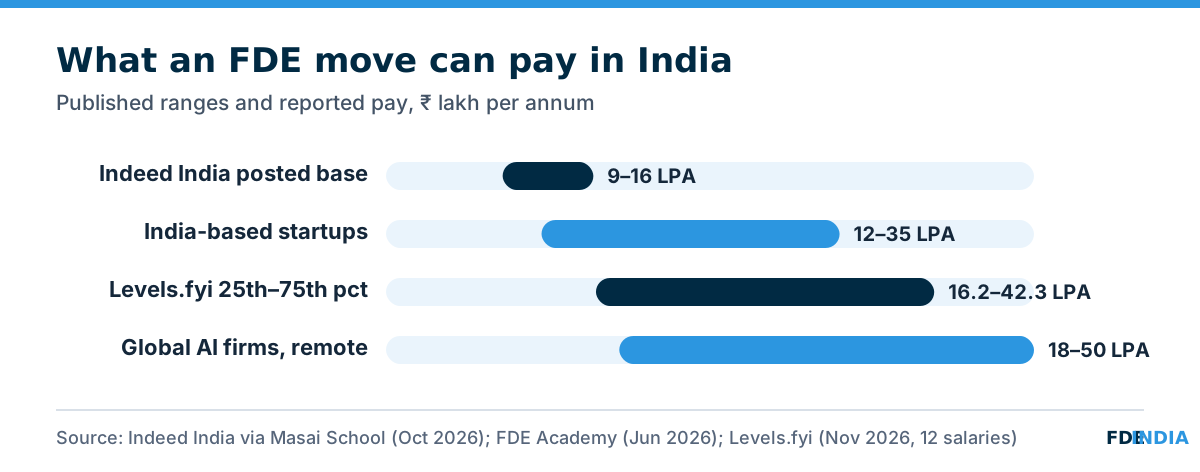 Ranges differ by source and by employer. Sources: Indeed India via Masai School (October 2026), FDE Academy (June 2026), Levels.fyi (November 2026).
- Indeed India: average posted base pay of about ₹12 lakh a year, within ₹9–16 lakh, as reported via IANS and cited by Masai School (October 2026).
- Levels.fyi: median total compensation of about ₹17.7 lakh, with the 25th–75th percentile at about ₹16.2–42.3 lakh and the 90th at about ₹56 lakh. This is based on only 12 salaries, as of 2 November 2026.
- FDE Academy’s estimates: ₹12–35 LPA at India-based startups and ₹18–50 LPA at international AI companies hiring remotely (June 2026).
Some training providers claim FDEs earn 15–30% more than equivalent software engineers, but none of the guides reviewed cites a source for it. Benchmark against live offers, not against that premium.
Is the switch right for you?
Scaler’s backend guide is frank about the trade-offs. FDE work means travel and on-site time that varies by client. Ambiguity can stretch working hours. And you go broad rather than deep. If you want predictable hours, a clean individual-contributor ladder or deep specialisation in one system, staying in backend may suit you better. If you like the moment your code meets a real business problem, the move makes sense. Our FDE skills guide has a fuller skills checklist.
Upload your resume and get a fit score, your top skill gaps and the roles you are closest to, in under a minute.
 Powered by Interview Kickstart
Frequently asked questions
Can a backend engineer become a forward deployed engineer?
Yes. Backend engineers are one of the most natural feeders because FDE work is heavy on APIs, data, integrations and cloud deployment. What usually needs work is client communication, production LLM skills and handling ambiguous problems.
How long does it take to switch from backend engineer to FDE?
Guides aimed at Indian engineers suggest anywhere from 90 days to six months of focused effort, and up to 12 months for people studying part-time around a full-time job. Long interview processes at some companies add time.
Do I need machine learning experience to become an FDE?
You need applied LLM skills rather than model research: building retrieval (RAG) pipelines, writing evaluations, handling bad outputs and deploying in a customer's cloud. Many India listings now ask for practical GenAI knowledge alongside backend work.
Do forward deployed engineers earn more than backend engineers in India?
Some training providers claim a 15–30% premium, but they do not publish a source for it. Reported India FDE pay ranges from about ₹9–16 lakh posted base on Indeed India to ₹18–50 LPA at global AI companies hiring remotely, so compare live offers rather than relying on a premium.
Get FDE Pulse in your inbox
New FDE jobs in India, who's hiring, pay in LPA and the week's guides, in one short email. Unsubscribe in one click.
Check your inbox for a welcome email from [email protected]. Your first FDE Pulse arrives on Sunday.
Sources
- Backend Engineer to Forward Deployed Engineer: The Fastest Path — Scaler, Oct 2026
- How to Transition from Software Engineer to Forward Deployed Engineer — Scaler, Aug 2026
- Backend engineer to forward deployed engineer — FDE Academy, Jun 2026
- Forward deployed engineer jobs in India, demand and who is hiring — Masai School, Oct 2026
- How to become a forward deployed engineer early in your career — Masai School, Oct 2026
- Demand for forward deployed engineers jumps 19-fold in India: report — People Matters (PTI), Oct 2026
- Forward Deployed Engineer Salary in India — Levels.fyi, Nov 2026
- Forward Deployed Engineer – OneByZero, Bengaluru (2 to 5 years) — GetMeReferred, May 2026
- Forward Deployed Engineer, Cloud Applied AI – Google, Bengaluru — foundit, Mar 2026