

Forward Deployed Engineer vs Software Engineer: Which Fits You?
- A software engineer builds the product for many customers; a Forward Deployed Engineer makes it work inside one customer's systems, often on-site.
- On Levels.fyi's India data, the median software engineer reports ₹30.7 LPA in total pay (21,335 reports) against ₹17.5 LPA for FDEs, but the FDE figure rests on only 12 reports.
- Like-for-like at top product firms and GCCs, Scaler estimates FDEs earn more: ₹18–35 LPA at entry level against ₹15–28 LPA for software engineers.
- Choose FDE if you enjoy customers, ambiguity and travel (Avaamo lists up to 40–50%); choose software engineering if you want deep, focused work on one system.
A software engineer builds and improves a product for all of its users. A Forward Deployed Engineer (FDE) takes that product into one customer’s world and makes it work there: their data, their legacy systems, their deadlines. Both write production code; the difference is who you build for and where you sit. If you like deep, focused work on one system, software engineering suits you better. If you like customers, ambiguity and seeing your code change a business within weeks, look hard at FDE.
This guide compares the two roles on daily work, pace, travel, growth and pay in India, and ends with a checklist to help you decide.
FDE vs software engineer: the core difference
Every source we checked lands on the same split. Great Learning says the primary difference is the scope of the engineering responsibilities: FDEs work directly with customers to integrate and deploy solutions, while software engineers build applications and services for a broad user base. Scaler Topics puts it more bluntly: “The fundamental difference is the Target Audience.” A software engineer’s stakeholders are internal (product managers and peers); an FDE’s are external (client CTOs and IT directors).
| Software engineer | Forward Deployed Engineer | |
|---|---|---|
| Builds for | All customers, through the product | One customer (or a few) at a time |
| Requirements come from | Product specs and roadmaps | Discovery calls and workshops with the customer |
| Typical work | Features, services, infrastructure, refactoring | Integrations, custom workflows, deployments, live debugging |
| Customer contact | Limited; feedback often arrives via support | Frequent and direct |
| Measured on | Product quality, reliability, delivery | Customer outcomes and successful go-lives |
| Work setting | Office or remote, a controlled environment | Client site, hybrid or remote; less predictable |
| Technical shape | Narrower and deeper | Broader: backend, data, some frontend, APIs, cloud |
Compiled from Great Learning (Oct 2026), Scaler Topics (Oct 2026) and Futurense (Jan 2026).
Scaler describes FDE work as a kind of technical archaeology: understanding how a client’s existing systems work, then writing the shims and connectors that let the product run inside them. A software engineer, by contrast, mostly works on code their own team owns.
For a fuller explanation of the role itself, start with what a Forward Deployed Engineer does.
What the work looks like in Indian job listings
Listings for FDE roles in India show the difference more clearly than any definition.
- HackerRank, Bengaluru (on-site), 3+ years, ₹30–45 LPA posted. The FDE leads customer discovery, pilots and demos as the main technical voice, and works on-site with customers. The stack asked for is practical rather than exotic: Python and SQL, enough full-stack depth to configure and debug web apps and integrations, and API scripting in Ruby or Python (YC job listing).
- Avaamo, Bengaluru (Koramangala). The agentic AI company’s FDE role mentions frequent travel to customer sites in the US and Europe, up to 40–50% of the time (Avaamo careers).
- DBSync, Bengaluru (remote), 4–8 years. This listing, removed on 5 October 2026 according to Built In Bengaluru, is a useful template of what the role asks: discovery workshops, turning requirements into workflows and integrations, owning the customer technically after onboarding, and feeding insights back to product. It wanted Python, Java or Go; REST and SOAP APIs, webhooks, OAuth and SSO; SQL with a BI tool; and, strongly preferred, hands-on LLM agent frameworks, RAG pipelines and eval design. It ran on a US shift, 6:30 PM to 3:30 AM IST.
Notice what is missing compared with a typical SDE listing: there is little about algorithms, scale or owning one service for years. The emphasis is on breadth, integration and communication with engineers and non-technical people alike.
Pace, travel and on-call
Pace. Futurense describes FDE work as fast-moving with frequently changing priorities, against the more structured, predictable development cycles of software engineering. Scaler’s fit list says FDEs are people who want new problems every month. If you enjoy finishing a hard problem slowly and well, that churn can be tiring.
Travel. This is the biggest lifestyle difference. Scaler says software engineers travel minimally, while 0–50% travel is common for FDEs, and lists travel fatigue as a real trade-off. Avaamo’s 40–50% figure sits at the top of that range. Not every role is like this: Futurense notes many FDE roles are now hybrid or remote with little travel, and the DBSync role was remote. Ask about travel in the first recruiter call.
Hours. Indian FDEs serving US or European customers often work their customers’ hours, as the DBSync US-shift listing shows. Software engineers at GCCs face overlap calls too, but FDEs carry the customer relationship, so escalations land on them.
Career growth: two different ladders
Scaler sets out two paths:
- Software engineer: Lead Engineer → Staff Engineer → Principal Engineer → CTO.
- FDE: Senior FDE → Technical Account Lead → VP of Engineering → Technical Founder.
Futurense describes FDEs moving into senior FDE, deployment lead or solution architect roles, while software engineers move to senior, staff, principal or engineering management.
The practical difference: the software engineering ladder is well understood by every Indian employer, so your level travels with you. The FDE title is newer. Second Talent’s rate card says the exact title is still barely used by Indian employers, which means FDE levels vary from company to company. On the other hand, FDEs collect customer, domain and business exposure that is hard to get as an SDE, and that is exactly what founding and leadership roles need. Our FDE career ladder maps FDE levels to SDE equivalents.
FDE vs software engineer salary in India
The pay picture depends heavily on which data you look at, so here are both views.
Self-reported data (Levels.fyi). On Levels.fyi’s India software engineer page, updated 11 November 2026, the median software engineer reports ₹30.7 LPA in total pay (base plus stock plus bonus), from 21,335 reports. The FDE India page, updated 10 November 2026, shows a median of ₹17.5 LPA from just 12 reports.
| Total pay, India | Software engineer | Forward Deployed Engineer |
|---|---|---|
| 25th percentile | ₹17.8 LPA | ₹14.9 LPA |
| Median | ₹30.7 LPA | ₹17.5 LPA |
| 75th percentile | ₹49.7 LPA | ₹41.9 LPA |
| 90th percentile | ₹70.4 LPA | ₹55.4 LPA |
| Reports | 21,335 | 12 |
Source: Levels.fyi, November 2026.
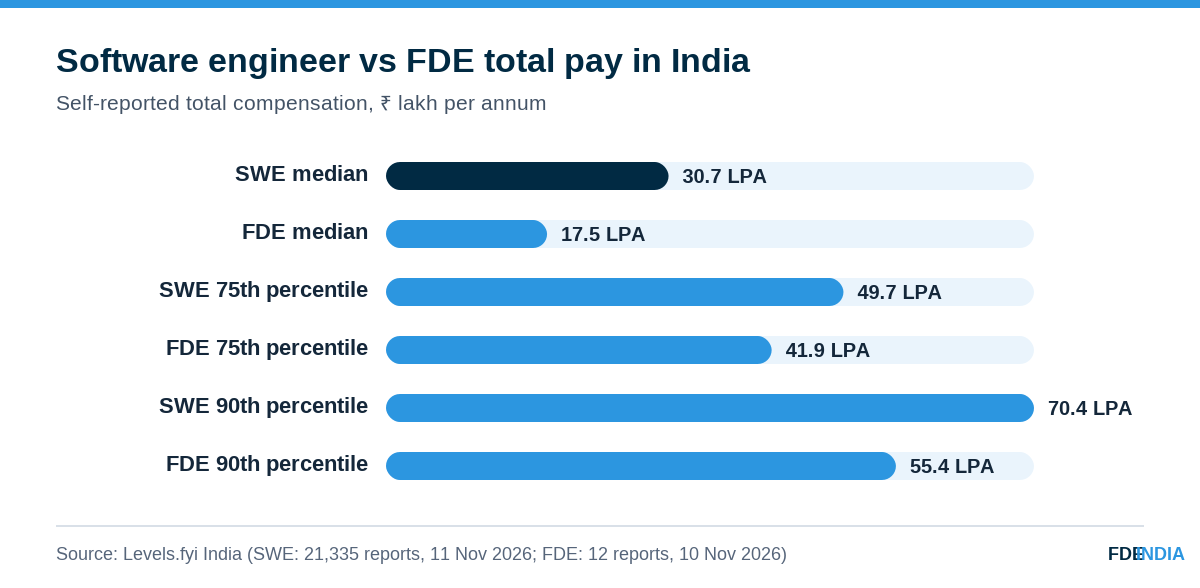 On self-reported data, software engineers lead at every point, but the FDE sample is only 12 reports. Levels.fyi, November 2026.
Read this carefully. Levels.fyi’s software engineer data is weighted towards big tech and well-paid product companies: its top-paying Indian cities are Hyderabad (₹42.2 LPA median) and Bengaluru (₹40.1 LPA). Twelve FDE reports can swing a lot with one or two entries, so the FDE median is a weak signal, not proof that FDEs earn less.
Like-for-like estimates (Scaler). When the employer tier is held constant, the picture flips. Scaler’s market estimates for top-tier product firms and GCCs put FDEs at ₹18–35 LPA at entry level against ₹15–28 LPA for software engineers, and senior FDEs at ₹65 LPA to ₹1.2 crore and above, against ₹45–85 LPA for senior software engineers. Scaler doesn’t name a survey behind these figures, so treat them as estimates.
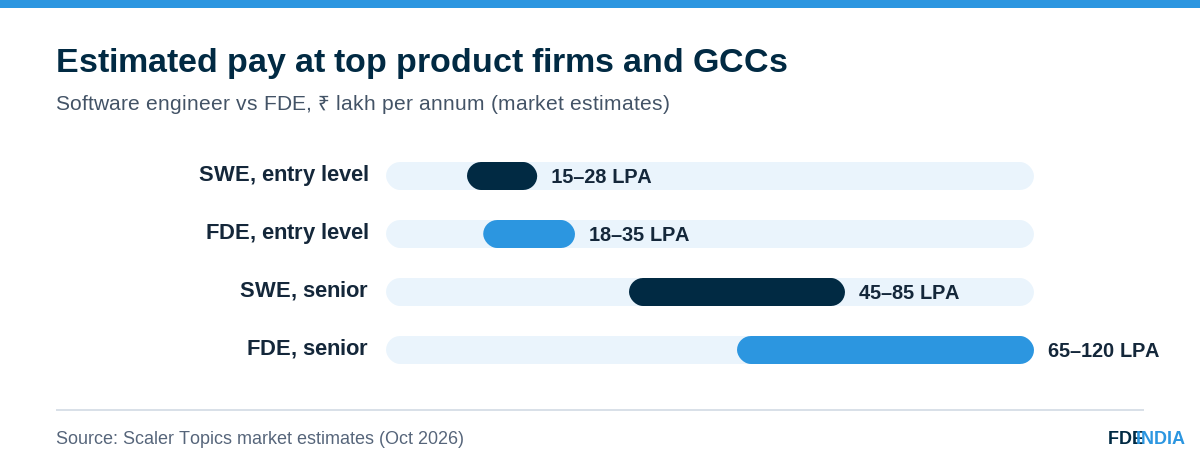 Within the same employer tier, FDE bands sit above software engineer bands. Scaler Topics market estimates, October 2026.
Broader averages tell the same story. Futurense, citing AmbitionBox, puts typical FDE pay at ₹10–20 LPA (up to about ₹30 LPA) against roughly ₹9 LPA for software engineers overall, a comparison that includes IT services salaries. Second Talent’s rate card gives FDE fixed-pay bands of ₹6–14 LPA (0–2 years), ₹14–28 LPA (3–6 years) and ₹28–65 LPA (6–10 years), with GCCs and US product companies at the top of every band.
The honest summary: an FDE role usually pays more than a software engineering role at the same company tier, but a software engineer at a top product company can out-earn an FDE at a smaller firm. Compare offers, not titles. Our salary hub has more FDE benchmarks.
Self-assessment: which role is right for you?
Tick the statements that are true for you.
Signs you’d enjoy the FDE role
- I like explaining technical things to non-engineers, and I don’t dread customer calls.
- I’d rather ship something useful this month than perfect something over a quarter.
- Messy, undocumented systems interest me more than they frustrate me.
- I’m comfortable with travel, client sites or customer time zones for parts of the year.
- I want business and domain exposure, maybe to found or lead something later.
- I’m a generalist: backend, data, APIs, a bit of frontend and cloud.
Signs software engineering suits you better
- I do my best work in long, uninterrupted blocks on one codebase.
- I want to go deep on one area, such as distributed systems, performance or infrastructure.
- Predictable sprints and a clear roadmap matter to me.
- I’d rather not be the person a customer calls when something breaks.
- I want a career ladder that every employer recognises.
If you ticked four or more in the first list, FDE is worth a serious look. The FDE Fit Check scores your current experience against the role in a few minutes.
How to test FDE before you switch: step by step
You don’t need to resign to find out. Most of the FDE skill set can be tried inside a software engineering job.
- Volunteer for customer-facing work. Join an escalation call, a customer onboarding or an integration project. Notice whether it energises or drains you.
- Ship one integration end to end. Connect your product to an external system through REST APIs, webhooks and OAuth, with logging and error handling. This is the bread-and-butter work in the HackerRank and DBSync listings.
- Build one LLM feature on real data. A retrieval or agent workflow with a simple evaluation set covers the RAG and eval skills listings now prefer.
- Write it up for a non-technical reader. A one-page summary of what you built and what changed for the user is practice for the discovery and demo side of the job.
- Talk to people in the role. Ask about travel, hours and how success is measured, then target employers whose answers fit you. Our backend engineer to FDE switch plan lays out a 90-day route.
Scaler estimates about 70% overlap in core engineering skills between the two roles, so a good software engineer is already most of the way there. The remaining 30% (customers, ambiguity and delivery under pressure) is what decides whether you’ll enjoy the job.
Frequently asked questions
Is a Forward Deployed Engineer the same as a software engineer?
No. Both write production code, but a software engineer builds and improves a product for its whole customer base, while an FDE adapts and deploys that product for specific customers, working directly with their teams. Great Learning puts the main difference down to the scope of engineering responsibilities.
Do FDEs earn more than software engineers in India?
It depends on the employer. Levels.fyi's self-reported India data shows a higher median for software engineers (₹30.7 LPA vs ₹17.5 LPA), but its FDE sample is just 12 reports. At top product firms and GCCs, Scaler's market estimates put FDE pay above software engineer pay at both entry and senior level.
Can a software engineer switch to an FDE role?
Yes, and it is the most common route in. Scaler estimates about 70% overlap in core engineering skills. The gap to close is customer discovery, integration with messy client systems and, increasingly, LLM deployment skills such as retrieval and evaluation.
Do FDEs travel a lot?
Often, but not always. Scaler says 0–50% travel is common, and Avaamo's Bengaluru FDE role mentions up to 40–50% travel to the US and Europe. Futurense notes that many modern FDE roles are hybrid or remote with little travel.
Where are you right now?
Get a feel for the role and the market first.
- Read next: Solutions Engineer vs Forward Deployed Engineer Salary in India →
- See the open FDE roles in India →
Get new FDE jobs and guides every Sunday
One short email a week: new verified FDE roles in India and the week's guides. Unsubscribe in one click.
Check your inbox for a welcome email from [email protected]. Your first FDE Pulse arrives on Sunday.
See where you stand, then close the gaps.
Prepare for the rounds FDE interviews actually test.
Keep going
Sources (9)
- Software Engineer Salary in India — Levels.fyi, Nov 2026
- Forward Deployed Engineer Salary in India — Levels.fyi, Nov 2026
- Forward Deployed Engineer vs Software Engineer: Key Differences for 2026 — Scaler Topics, Oct 2026
- Forward Deployed Engineer vs Software Engineer: Roles, Skills, Salary, and Career Paths Explained — Futurense, Jan 2026
- Forward Deployed Engineer vs. Software Engineer: What Is the Difference? — Great Learning, Oct 2026
- Forward Deployed Engineer Salary India (rate card) — Second Talent, Sep 2026
- Forward Deployed Engineer at HackerRank — Y Combinator, Nov 2026
- Forward Deployed Engineer (FDE), Avaamo careers — Avaamo, Nov 2026
- Forward Deployment Engineer, DBSync — Built In Bengaluru, Oct 2026

I help engineers move into AI roles that actually pay off. Former software tester and Android developer; I now work with engineers aiming for top product companies, and track FDE hiring in India every week.
LinkedIn profile