

Become an FDE in 6 Months: Roadmap by Engineering Background
- Six months is a realistic window to become FDE-ready if you have about 2+ years of production engineering experience and can give it roughly 10–12 hours a week. It is not realistic from zero.
- Indian FDE listings ask for six skills: production coding, APIs and integrations, cloud and deployment, data and SQL, applied AI (RAG, agents, evals) and customer-facing work. No background starts with all six.
- Backend and full-stack engineers start strongest on code and integrations; data engineers on data; cloud and DevOps engineers on deployment; test engineers have a real edge in AI evaluation.
- Almost everyone needs to add applied AI and customer-facing work. Those two are what turn a strong engineer into an FDE.
- Published FDE pay bands in India run from ₹30–50 LPA at 3–6 years to ₹50–80 LPA at 7–12 years (Taggd).
Most engineers who want to become a Forward Deployed Engineer (FDE) already have half the skills. A data engineer knows pipelines, a DevOps engineer knows production, a backend engineer knows APIs. What separates a strong engineer from an FDE is the rest: building AI systems that work on real customer data, and owning a deployment in front of the customer.
This guide shows, for six common backgrounds, what engineering depth you already bring, what to add, and how to get FDE-ready in six months.
Is six months realistic?
Yes, with two conditions:
- You have about 2+ years of production engineering. Most Indian FDE listings ask for experience: Razorpay’s FDE role asks for 3+ years shipping production software. Six months is enough to add the FDE layer on top of real experience, not to build an engineer from scratch. Freshers should read our guide for freshers instead.
- You can give it about 10–12 hours a week. That is our estimate for a working engineer, not a fixed rule: two weekday evenings and a longer weekend block, or roughly 250–300 hours over six months.
Demand makes the timing worth it. Indeed India counted FDE job postings at nearly 19 times the year-ago level in June 2026.
What a complete FDE looks like: six skills
Indian FDE listings ask for six things. Our FDE skills guide covers each with the listing evidence.
- Production coding: shipping and owning real software, usually in Python or TypeScript.
- APIs and integrations: REST, webhooks, SDKs, authentication, connecting to CRMs, ERPs and ticketing tools.
- Cloud and deployment: AWS, GCP or Azure, containers, Kubernetes, observability.
- Data and SQL: getting a customer’s data into a usable shape.
- Applied AI: LLM prompts, tool calling, retrieval (RAG), agents and evaluation.
- Customer-facing work: discovery, scoping, explaining trade-offs and owning outcomes. Evnek Technologies’ Bengaluru listing, for example, wants FDEs who run discovery independently and write statements of work that clients sign.
What each background brings, and what to add
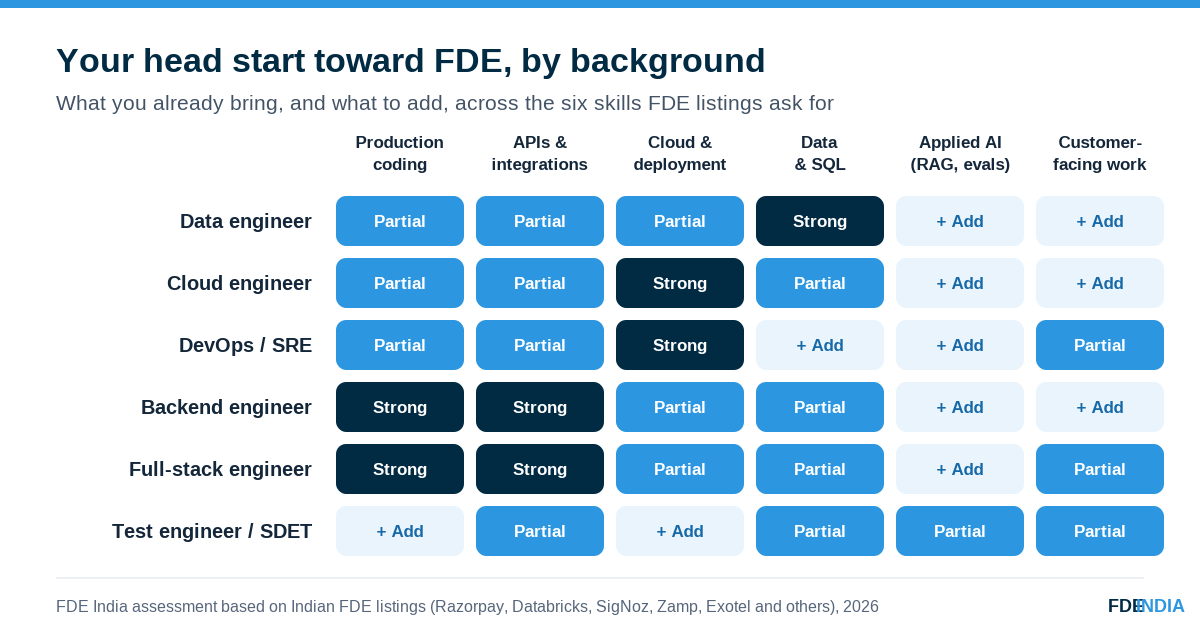 Our assessment of where each background typically starts, based on what Indian FDE listings ask for. Your own experience may differ: check it with the FDE Fit Check.
Two patterns stand out. Almost everyone needs to add applied AI and customer-facing work, and each background brings depth in a different part of the stack, which decides which FDE roles suit you best.
Data engineer
Depth you bring: production pipelines, data modelling, data quality, SQL and Python, debugging live data systems. Bad data is the most common reason AI systems give wrong answers, so this depth is valuable in FDE work.
What to add: integrations beyond the data stack (CRM and ERP APIs, authentication), retrieval and agents on top of the data you prepare, and customer-facing communication.
Roles that suit you: data-platform FDE roles such as Databricks’ AI Engineer - FDE (5+ years) in Bengaluru and remote India. Read the full data engineer to FDE guide.
Cloud engineer
Depth you bring: cloud architecture, networking, identity and access, security reviews, infrastructure as code. FDEs often deploy into a customer’s own cloud, where these skills decide whether a project ships at all.
What to add: application code you own end to end (an API service, not only infrastructure), applied AI, and discovery with business users.
Roles that suit you: infrastructure-heavy FDE roles. Zamp’s Forward Deployed Infrastructure Engineer role in Bengaluru asks for 4+ years in infrastructure, platform, DevOps, SRE or solutions architecture, plus production experience with AWS, Azure or Google Cloud.
DevOps or SRE engineer
Depth you bring: CI/CD, Kubernetes, observability, incident handling and keeping systems running under pressure. Analytics India Magazine reported that Han Digital Group sees taking AI from prototype to reliable production, with evaluations, observability, guardrails and monitoring, as the hardest FDE capability to find.
What to add: product-level application code, data and SQL, applied AI, and turning customer requests into scoped work.
Roles that suit you: SigNoz’s remote-India Forward Deployed Engineer role asks for 2–6 years in DevOps, SRE, platform or solutions engineering, with containers, Kubernetes, infrastructure as code and a major cloud. The job: design customers’ OpenTelemetry setups and contribute hands-on to their codebases.
Backend engineer
Depth you bring: APIs, services, systems design, production debugging, integrations. This is the core of most FDE work, which is why backend engineers usually have one of the shortest paths.
What to add: applied AI (RAG, agents, evals), owning a deployment in front of the customer, and enough cloud to deploy into someone else’s environment.
Roles that suit you: most product-company FDE roles, such as Razorpay’s FDE role in Agent Studio (3+ years, Python or TypeScript, APIs, webhooks, auth, LLM or agent experience). Read the full backend engineer to FDE guide.
Full-stack engineer
Depth you bring: end-to-end delivery from database to UI, fast prototyping and product sense. FDEs often build the interface a customer actually uses. Second Talent notes OpenAI’s FDE role requires production code across frontend and backend.
What to add: depth in production operations (monitoring, incidents, scaling), data handling, and applied AI beyond calling an API.
Roles that suit you: AI start-ups and product companies where FDEs build complete customer-facing solutions, often as the main engineer a customer works with.
Test engineer or SDET
Depth you bring: test design, automation frameworks, regression suites, edge-case thinking and CI quality gates. These map directly onto LLM evaluation. Future AGI describes what carries over: the test harness, the golden set as a regression suite, CI gates that block bad releases, and adversarial testing. What changes is that pass/fail assertions become graded scores against a rubric. Exotel’s FDE listing, for example, asks FDEs to build reusable “eval packs”.
What to add: production coding is the biggest gap, writing and owning the system rather than testing it. Add cloud deployment and customer-facing work too. This is usually the longest path of the six, but the evaluation skills give you a real edge.
Roles that suit you: FDE and applied AI roles at AI start-ups where evaluation quality decides whether a deployment succeeds.
Your 6-month roadmap
Each month builds on the last. The “shortcut” notes tell you where your background lets you move faster.
| Month | Focus | You should finish with |
|---|---|---|
| 1 | Strengthen your weakest core skill | One small service you wrote, tested and deployed |
| 2 | Applied AI: LLMs, tool calling, retrieval | A working RAG app on a real document set |
| 3 | Agents and evaluation | An agent with an evaluation set that scores its answers |
| 4 | Deploying into someone else’s environment | Integrations with auth, logging, monitoring and a runbook |
| 5 | One end-to-end project, scoped like a customer engagement | A deployed system, a written case study and a 5-minute walkthrough |
| 6 | Interview preparation and applications | Practised decomposition and deployment-scenario rounds; applications out |
Month 1, the shortcut by background:
- Backend and full-stack: skip ahead to cloud deployment and observability.
- Data: build an API service with authentication.
- Cloud and DevOps: write and own application code, not only infrastructure.
- Test engineers: build and run a small production service yourself; this month matters most for you.
Months 2–3, the shortcut: test engineers will find evaluation familiar, so go deeper into rubric design and grading. Data engineers can move faster on retrieval pipelines.
Month 4, the shortcut: cloud and DevOps engineers will be quickest here. Use the time on discovery practice instead.
Month 5 is the most important. Treat the project like a real engagement: find a real user (a friend’s business, a college club, an NGO), scope the problem with them, build, deploy, measure the result and write it up. FDE hiring managers look for proof that you have taken something to production, and this project is that proof.
Month 6: learn the FDE interview process and practise the common FDE interview questions, especially decomposition and deployment scenarios.
Every month: practise the customer side. Once a week, explain a technical trade-off to a non-technical person in five minutes. FDE interviews test this directly.
What to show by the end of month 6
- A deployed system someone actually used, with the before-and-after result.
- A written case study: the problem, how you scoped it, what you built, what went wrong and what you would do differently.
- An evaluation report showing how you measured AI output quality.
- A 5-minute walkthrough recorded for a non-technical listener.
- A resume rewritten around deployment outcomes, not tools.
Where you can land, and what it pays
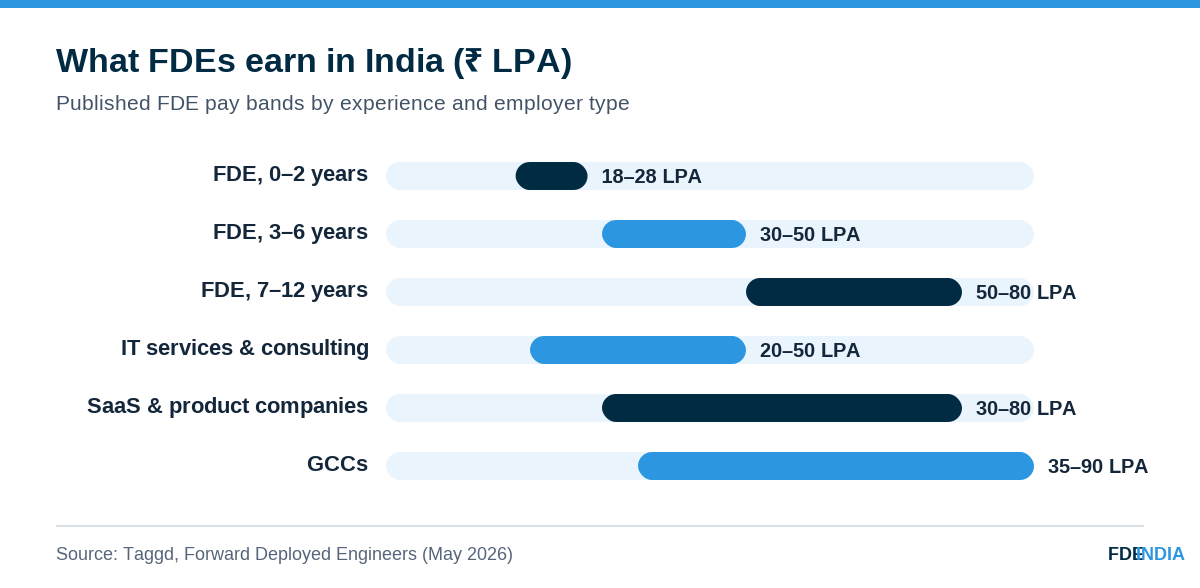 Taggd’s published FDE pay bands, May 2026.
Taggd puts FDE pay in India at ₹30–50 LPA for 3–6 years and ₹50–80 LPA for 7–12 years, with GCCs at ₹35–90 LPA and IT services at ₹20–50 LPA. Check your own band with the FDE Salary Estimator, and see who is hiring on our companies list.
Doing it with structure
Six months on your own works if you stay disciplined. If you would rather have a structured, live path with practice interviews, the free FDE masterclass by Interview Kickstart walks through what FDE roles need and how to prepare.
Not sure where you start? Run your resume through the free FDE Fit Check to see your gaps across these six skills in about a minute.
Frequently asked questions
Can I become a Forward Deployed Engineer in 6 months?
Yes, if you already have about two or more years of production engineering experience in data, cloud, DevOps, backend, full-stack or test engineering, and can spend roughly 10–12 hours a week. Six months is enough to add applied AI, build one deployed end-to-end project, practise customer-facing work and prepare for FDE interviews. Starting from zero, plan for longer.
Which engineering background is best for becoming an FDE?
Backend and full-stack engineers usually have the shortest path, because production coding and integrations are the core of FDE work. Data, cloud and DevOps engineers bring depth that many FDE teams lack and fit data-platform and infrastructure-heavy FDE roles. Test engineers have the longest path on production coding but a real advantage in AI evaluation.
Can a test engineer or SDET become a Forward Deployed Engineer?
Yes. Test design, automation harnesses, regression suites and CI gates map directly onto LLM evaluation, which FDE roles increasingly ask for. Test engineers need to add production coding (writing and owning the system, not only testing it), cloud deployment and customer-facing work.
Can a DevOps or cloud engineer become an FDE?
Yes, and some FDE roles are built for that background. SigNoz's remote-India FDE role asks for 2–6 years in DevOps, SRE or platform engineering, and Zamp's Forward Deployed Infrastructure Engineer role in Bengaluru asks for 4+ years in infrastructure, platform, DevOps or SRE. The gaps are usually application code, applied AI and discovery with customers.
How many hours a week do I need to become FDE-ready in 6 months?
Our estimate for a working engineer is about 10–12 hours a week: two weekday evenings and a longer weekend block. That adds up to roughly 250–300 hours over six months, enough for one deployed project, focused AI skill-building and interview practice. It is an estimate, not a fixed requirement.
Where are you right now?
Get a feel for the role and the market first.
- Read next: Solutions Engineer to Forward Deployed Engineer: The Coding Gap →
- See the open FDE roles in India →
Get new FDE jobs and guides every Sunday
One short email a week: new verified FDE roles in India and the week's guides. Unsubscribe in one click.
Check your inbox for a welcome email from [email protected]. Your first FDE Pulse arrives on Sunday.
See where you stand, then close the gaps.
Prepare for the rounds FDE interviews actually test.
Keep going
Sources (12)
- Forward-Deployed Engineer, Agent Studio — Razorpay — Razorpay careers, 2026
- Forward Deployed Engineer (Remote, India time zones) — SigNoz — Y Combinator Work at a Startup, 2026
- Forward Deployed Infrastructure Engineer — Zamp, Bengaluru — Zamp careers, 2026
- Forward Deployed Engineer - 1 — Exotel — Exotel careers, 2026
- Forward Deployed Engineer - LLM/Gen AI — Evnek Technologies — fwddeploy, 2026
- Forward Deployed Engineer III, Generative AI, Google Cloud — Google Careers, 2026
- AI Engineer - FDE (Forward Deployed Engineer) at Databricks in India — Outscal, 2026
- Forward deployed engineer vs solutions architect — Second Talent, Oct 2026
- LLM eval vs traditional QA in 2026 — Future AGI, May 2026
- Indian engineers are jack of all trades, but FDE roles demand master of AI — Analytics India Magazine, Sep 2026
- Demand for Forward Deployed Engineers jumps 19-fold in India: report — People Matters (PTI, Indeed India data), Oct 2026
- Forward Deployed Engineers: roles, responsibilities, skills, salary — Taggd, May 2026

I help engineers move into AI roles that actually pay off. Former software tester and Android developer; I now work with engineers aiming for top product companies, and track FDE hiring in India every week.
LinkedIn profile