

Forward Deployed Engineer Projects: 5 Builds That Get Hired
- Across nine open India FDE listings checked on 19 November 2026, customer work or handover docs appear in all nine, deployment and debugging in eight each, and customer-system integration in seven.
- LLM agents or RAG appear in only four of the nine, so a portfolio of chatbots alone covers less than half of what these employers ask for.
- Shipsy asks applicants for a link to a system they built end to end, and Gushwork asks for at least one full web app, at work or as a personal project.
- Posted pay on three of the listings runs from ₹10–13 LPA (Peakflo, 0.5–2 years) to ₹30–45 LPA (HackerRank, 3+ years).
The best forward deployed engineer projects prove you can do the whole job: connect to a customer’s messy systems, deploy, keep it running and hand it over. A chatbot alone doesn’t do that. In nine open India FDE listings checked on 19 November 2026, deployment and debugging each appeared in eight, while LLM agents or RAG appeared in four.
Below are five builds, each tied to what those listings ask for, plus how to present them and the order to build them in.
What nine open India FDE listings ask you to ship
We read nine FDE listings for India that were open on 19 November 2026: HackerRank and Cekura in Bengaluru, Peakflo and SigNoz (remote, India), Prodigal (Bengaluru), Shipsy (Gurugram), Gushwork (Bengaluru), GlobalLogic (seven Indian cities) and Databricks (Bengaluru). For each we noted which kinds of work the listing names.
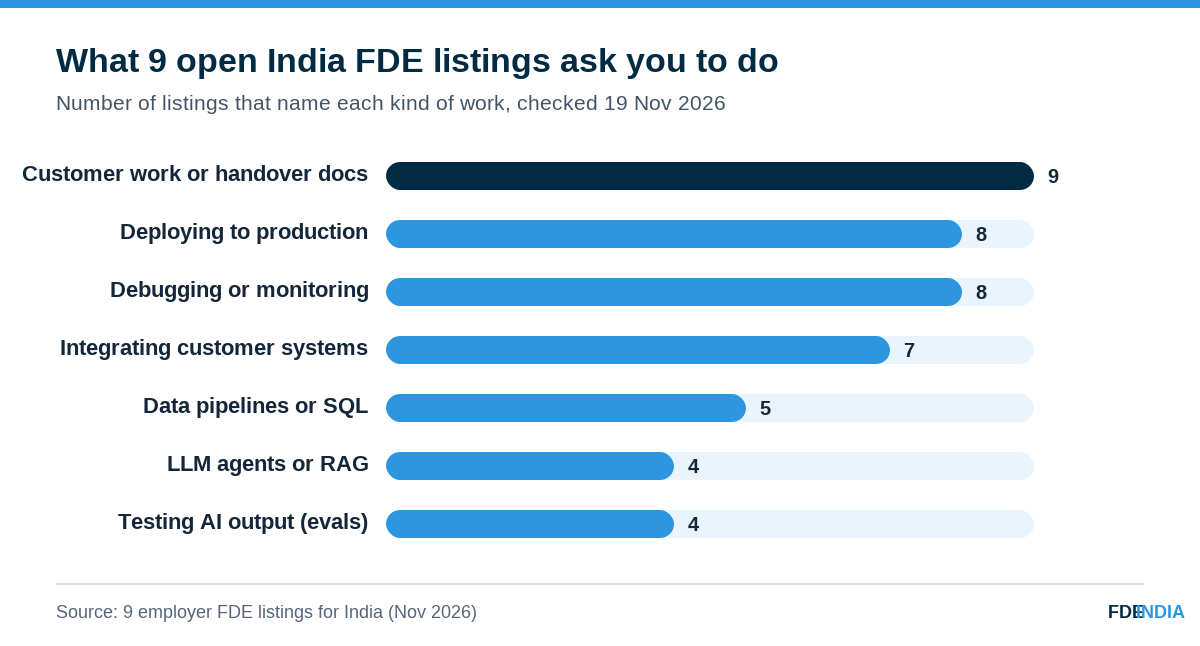 Deployment, debugging and integration beat LLM work by a wide margin. Data: nine employer listings, checked 19 Nov 2026.
Three things stand out:
- Integration is the core skill. Shipsy’s listing names SAP, Oracle, TMS, WMS and custom legacy systems. GlobalLogic’s financial-services role talks about legacy core-banking systems and rigid enterprise APIs. Databricks says its FDEs deliver by integrating with client systems.
- You own what breaks. Shipsy’s listing puts it bluntly: “When the integration breaks at 2am, you’re the one accountable.” Gushwork asks FDEs to fix bugs and keep customer products running.
- AI is common but not universal. Peakflo, Prodigal, Shipsy and GlobalLogic ask for agents or RAG. HackerRank, SigNoz, Gushwork and Databricks don’t name LLM building at all.
Two employers ask for portfolio evidence directly. Shipsy’s application asks for a link to a system you built end to end and what made it work. Gushwork asks for at least one full web app, built at work or as a personal project.
Build 1: The legacy bridge
What it proves: integration with customer systems (seven of nine listings) and debugging.
Pick two systems that were never designed to talk to each other and make them talk reliably. A good Indian example: a nightly CSV or Excel export that a small business’s accounting software produces, pushed into a modern REST API or a Google Sheet dashboard. Or a SOAP or XML service (many free public ones exist) wrapped in a clean JSON API.
What makes it FDE-grade rather than a weekend script:
- A field-mapping document: which column becomes which field, and what happens with blanks, bad dates and duplicate rows.
- Retries and idempotency, so running the sync twice doesn’t create duplicates.
- A failure log someone non-technical can read (“Row 214 skipped: GSTIN missing”).
- A short note on what you’d ask the customer’s IT team before going live: credentials, rate limits, data residency.
Build 2: The one-command customer install
What it proves: deployment (eight of nine) and customer handover docs.
Take an open-source app you didn’t write and deploy it as if into a customer’s environment. Package it with Docker, add infrastructure as code (Terraform or plain scripts), and make the whole thing come up with one command on a fresh cloud VM.
SigNoz’s listing asks for containers, Kubernetes and infrastructure as code. Databricks asks for familiarity with CI/CD for production deployment. Gushwork simply says deploy and maintain what you build.
The deliverable that matters most here is the runbook: install steps, how to upgrade, how to roll back, and the three most likely errors with fixes. SigNoz’s listing asks FDEs to write troubleshooting docs and best-practice guides for customers, and that kind of document is what a customer keeps after you leave. Write it so someone else could do the install without messaging you.
Build 3: The incident drill
What it proves: debugging and monitoring (eight of nine).
Instrument an app (your Build 1 or 2 works) with logs, metrics and traces, using OpenTelemetry and any free dashboard. Set one real alert. Then break it on purpose: kill the database, flood an endpoint, expire a credential.
Write a one-page postmortem: what the alert showed, how long it took you to find the cause, the fix, and what you changed so it won’t recur. Cekura’s listing asks FDEs to set up enterprise observability and useful alerts; SigNoz wants people who can debug customers’ instrumentation. A postmortem is also a ready-made answer to the “tell me about a production issue” interview question covered in our FDE interview process guide.
Build 4: The agent with a scorecard
What it proves: LLM agents or RAG (four of nine) and testing AI output (four of nine).
Build one agent for a real business workflow, not a general chatbot. Peakflo’s listing describes finance agents and RAG over enterprise knowledge; Prodigal asks FDEs to build and deploy LLM-powered agents and design evaluation frameworks for accuracy, latency and reliability. Shipsy mentions invoice reconciliation agents.
So: an agent that matches invoices against purchase orders, or answers “what’s the status of my claim?” by calling two APIs. Then build the part most candidates skip, a test set of 50 or more cases with expected answers, and report accuracy and latency before and after each change.
We’ve covered the AI skills in detail, with smaller exercises for each, in LLM skills every FDE needs. Don’t repeat all of them here; one well-measured agent is enough for a portfolio.
Build 5: The real-user build
What it proves: customer work (nine of nine) and owning the whole job.
Gushwork’s listing sums up the role as “you own the whole job for a customer”: run discovery, build, deploy, train their team, answer their questions. The only way to show that is to do it for someone real.
Find one user with a real problem: a relative’s shop, your college placement office, a local NGO, a friend’s clinic. Do a proper discovery call and write down the problem in their words. Ship something small, train them on it, and check back after two weeks. Record one number: hours saved, orders tracked, errors caught.
This is the project interviewers ask about most, because it has the things a tutorial can’t fake: a person who disagreed with you, a requirement that changed and a result you can measure.
The five builds side by side
| Build | Listing asks it covers | Employers that name this work | Time (evenings and weekends) |
|---|---|---|---|
| 1. Legacy bridge | Integration, debugging | Shipsy, GlobalLogic, Databricks, HackerRank, Cekura | 2 weeks |
| 2. One-command install | Deployment, handover docs | SigNoz, Databricks, Gushwork, Shipsy | 1–2 weeks |
| 3. Incident drill | Monitoring, debugging | SigNoz, Cekura, Shipsy, Prodigal | 1 week |
| 4. Agent with a scorecard | LLM agents, evals, data | Peakflo, Prodigal, Cekura, GlobalLogic | 2–3 weeks |
| 5. Real-user build | Customer work, end-to-end ownership | Gushwork, HackerRank, Shipsy | 3–4 weeks, part time |
The time column is our planning estimate, not a figure from the listings.
Presenting a project the way an FDE would
Employers can’t see your code quality in a 30-second scan, so every project needs three things:
- A deployment memo (one page). Customer problem, constraints, what you built, what broke, the number that moved. Write it like a handover to the customer’s engineering lead.
- A three-minute walkthrough video. Show it running, then show a failure and how you’d find it. Explaining clearly is half the FDE job; HackerRank’s listing asks FDEs to lead discovery, pilots and demos.
- A README that starts with “How to run this”. One command, then known issues. Put architecture diagrams below that.
On your resume, list each project with the same who, what and result format as a job. Our FDE resume guide has before-and-after examples.
What the pay looks like once you’re in
Three of the nine listings post pay, all on Y Combinator’s Work at a Startup board. Peakflo offers ₹10–13 LPA for 0.5–2 years of experience (remote), Cekura ₹15–30 LPA for 1+ years in Bengaluru, and HackerRank ₹30–45 LPA for 3+ years in Bengaluru. The other six don’t publish pay. Our salary hub tracks more posted ranges.
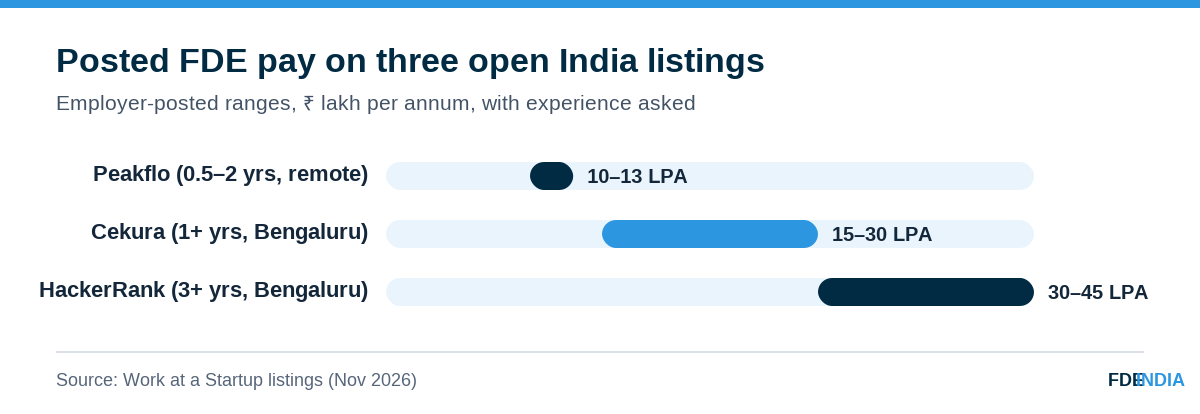 Posted pay rises steeply with experience, even among startups. Data: Work at a Startup listings, Nov 2026.
Experience asked across the nine runs from 0.5 years (Peakflo) and 1–2 years (Gushwork) up to 6+ years (Databricks) and 10–15 years (GlobalLogic). Portfolio projects matter most at the junior end, where your job history alone can’t prove you’ve done customer-facing delivery.
A 10-week build order by background
Don’t build all five at once. Start where your current job is weakest.
- Weeks 1–2: Build 1 (legacy bridge). Everyone. Integration came up in seven of nine listings, and it’s the base for Builds 2 and 3.
- Weeks 3–4: Build 2 (one-command install) on top of Build 1. Skip to week 5 if you already deploy to production at work.
- Week 5: Build 3 (incident drill) on the same app. Write the postmortem the same week, while you remember the details.
- Weeks 6–8: Build 4 (agent with a scorecard). Put this earlier if you’re targeting AI startups such as Peakflo or Prodigal; push it later if you’re aiming at platform roles like Databricks or SigNoz.
- Weeks 6–10, in parallel: Build 5 (real-user build). Start discovery in week 6 so you have two weeks of usage data by week 10.
- Week 10: Package. Memo, video and README for each, then update your resume and apply to the roles on our job board.
Freshers: Builds 1, 2 and 5 together are a stronger signal than any certificate; our fresher FDE guide covers which roles take new graduates. Engineers with 3+ years: your work projects can stand in for Builds 1–3. Spend your time on Builds 4 and 5, and write deployment memos for the work you’ve already shipped.
Not sure which gaps to fill first? The FDE Fit Check scores your background against the skills FDE listings ask for.
Frequently asked questions
What projects should I build to become a forward deployed engineer?
Build projects that show the whole FDE job, not only AI: an integration between two real systems, a one-command deployment with a runbook, a monitored app with an incident write-up, an agent with an eval set, and one build for a real user. In nine open India listings, deployment, debugging and integration came up far more often than LLM work.
Do FDE employers in India actually look at portfolios?
Some ask for them directly. Shipsy's Gurugram FDE application asks for a link to a system you built end to end, and Gushwork's Bengaluru listing asks for at least one full web app, which can be a personal project. Others never mention public work, so treat the portfolio as interview material as much as a link.
How many portfolio projects does an FDE candidate need?
Two or three finished, deployed projects with clear write-ups beat five half-built ones. Pick the projects that cover the gaps in your current job: integration and deployment if you come from AI work, evals and customer handover if you come from backend or support.
Should FDE portfolio projects use AI?
One should, because four of the nine India listings checked ask for LLM agents or RAG and four ask for testing AI output. But the other projects should show integration, deployment and debugging, which more of the listings name.
Where are you right now?
Get a feel for the role and the market first.
- Read next: Forward Deployed Engineer Resume: How to Get Shortlisted →
- See the open FDE roles in India →
Get new FDE jobs and guides every Sunday
One short email a week: new verified FDE roles in India and the week's guides. Unsubscribe in one click.
Check your inbox for a welcome email from [email protected]. Your first FDE Pulse arrives on Sunday.
See where you stand, then close the gaps.
Prepare for the rounds FDE interviews actually test.
Keep going
Sources (9)
- Forward Deployed Engineer at HackerRank — Y Combinator Work at a Startup, Nov 2026
- Forward Deployed Engineer (FDE) - (India/Remote) at Peakflo — Y Combinator Work at a Startup, Nov 2026
- Forward Deployed Engineer (Remote) (India time zones) at SigNoz — Y Combinator Work at a Startup, Nov 2026
- Forward Deployed Engineer - AI Agents @ Prodigal — Menlo Ventures Job Board, Oct 2026
- Forward Deployed Engineer at Cekura — Y Combinator Work at a Startup, Nov 2026
- Forward Deployed Engineer — Shipsy Careers, Nov 2026
- Forward Deployed Engineer — Gushwork (Lever), Nov 2026
- Forward Deployed Engineer IRC300053 — GlobalLogic Careers, Aug 2026
- Senior Forward Deployed Engineer @ Databricks — Thrive Capital Job Board, Aug 2026

I help engineers move into AI roles that actually pay off. Former software tester and Android developer; I now work with engineers aiming for top product companies, and track FDE hiring in India every week.
LinkedIn profile