

Forward Deployed Engineer Resume: How to Get Shortlisted
- Of 41 open FDE listings on the FDE India job board (verified 13 Nov 2026), 40 highlight customer-facing work, 36 production coding and 35 AI or LLM systems, so a shortlisted resume shows all three.
- Minimum experience asked clusters at 5–6 years (13 listings), but 9 listings ask for 2 years or less, so freshers and juniors do have a way in.
- A strong FDE bullet names the customer or user, what you shipped into their environment, and a result they cared about; tool lists alone don't count.
- Only 5 of the 41 listings post pay, from 10–13 LPA at Peakflo (up to 2 years) to 33–40 LPA at SambaNova (5+ years).
A forward deployed engineer resume gets shortlisted in India when it proves three things on the first page: you write production code, you work directly with customers, and you can build with AI systems. Most engineers have done at least two of these, but their resumes describe tasks and tools instead of who used the work and what changed. This guide shows what current listings ask for, then rewrites real-style bullets so they read like FDE work.
What FDE recruiters in India scan for first
FDE screening is narrower than a general software engineering screen. Paraform, a recruiting firm that places FDEs, lists five things it screens for: production code shipped in customer environments, customer communication, comfort with ambiguity, domain fit, and willingness to travel or work on-site. Interview Kickstart’s analysis of 14 FDE postings in August 2026 found stakeholder communication named in 13, production coding in 12 and LLM or agent development in 12.
So a recruiter reading your resume is effectively asking:
- Did this person ship code that ran somewhere real? Not a notebook, not a demo.
- Did they face a customer, client or end user? Calls, workshops, escalations, rollouts.
- Can they build with LLMs? RAG, agents, evals, not just “used ChatGPT”.
- Will they cope with mess? Legacy systems, unclear requirements, data they didn’t design.
If your first half-page doesn’t answer at least the first two, the rest rarely gets read.
What 41 open India FDE listings ask for
We tallied the skill areas highlighted in the 41 open FDE listings on the FDE India job board, each checked on the employer’s page on 13 November 2026. Customer-facing work appears in 40 of them, writing production code in 36 and AI or LLM systems in 35. Data work (24), APIs and integrations (21) and cloud (15) come next.
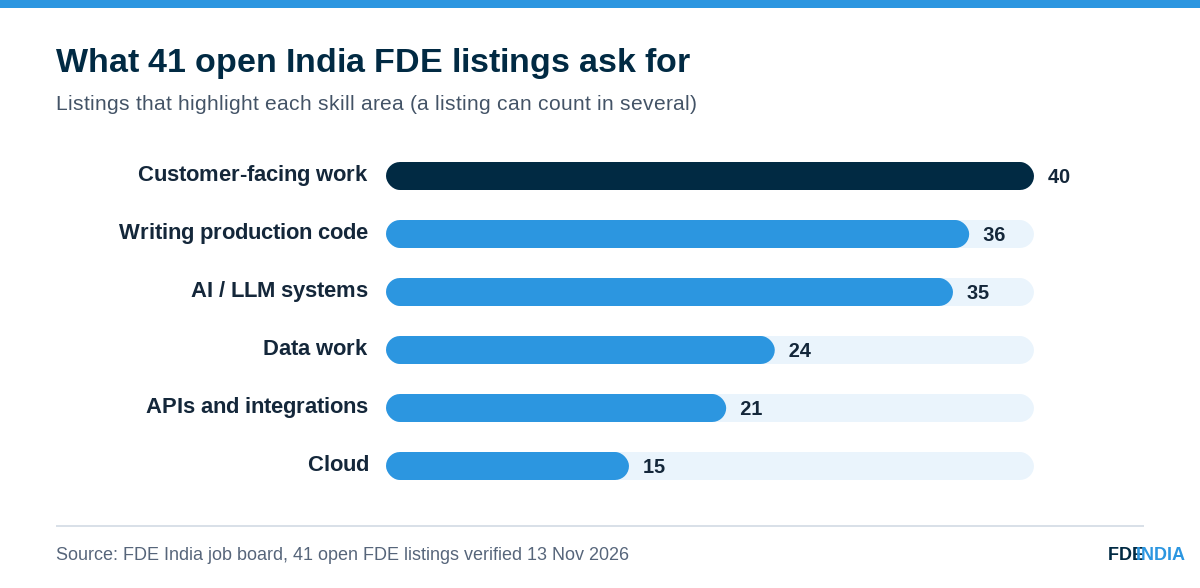 Customer-facing work is almost universal; cloud is the least common ask. Data: FDE India job board, 13 Nov 2026.
Two things follow for your resume. First, customer contact is not a “soft skill” line at the bottom; it belongs inside your strongest bullets. Second, generic cloud certifications carry less weight than you might think. Spend that space on a deployment story instead.
The wording in listings tells you which verbs to use. Nanonets’ Bengaluru FDE listing asked for “hands-on experience building production LLM systems” and the ability to own problems end to end. Google’s Cloud Applied AI FDE listing in Bengaluru described partnering with strategic customers to design, debug and deploy AI agents. Both listings are now closed, but the language is typical: build, deploy, own, partner. If your bullets say “assisted”, “was involved in” or “worked on”, rewrite them.
For the detail behind each skill area, see our guides to FDE skills Indian employers want and the LLM skills every FDE needs.
Match the resume to your experience band
The same resume can’t work for a 1-year and a 9-year engineer. On the job board, the most common minimum ask is 5–6 years (13 listings), but 9 listings ask for 2 years or less.
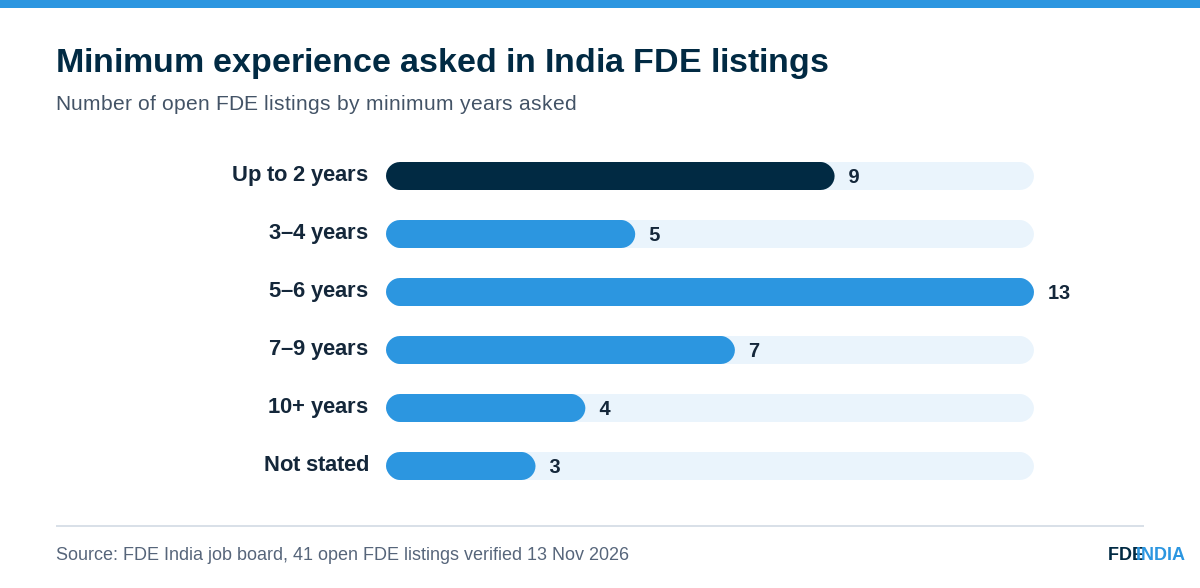 Mid-career asks dominate, but there is a real early-career band. Data: FDE India job board, 13 Nov 2026.
What should lead the page changes with the band:
| Your experience | What to lead with | What recruiters need to see | Example listing on the board |
|---|---|---|---|
| 0–2 years | Two deployed projects, then internships | Something real users touched; fast learning | Peakflo (remote, up to 2 years, 10–13 LPA posted) |
| 3–6 years | Two or three customer-facing delivery stories | Integrations you owned; one AI build | HackerRank (Bengaluru, 3+ years, 30–45 LPA posted) |
| 7–10 years | Large rollouts and technical direction | Ownership of outcomes, evals, reliability | SambaNova (Bengaluru, 5+ years, 33–40 LPA posted) |
| 10+ years | Programmes and client leadership | Setting direction across accounts; mentoring | GlobalLogic (5 cities, 10+ years, pay not posted) |
Only 5 of the 41 listings post pay, so treat these figures as examples, not benchmarks. Our salary hub has the wider picture, and the guide on experience required for FDE roles explains how strictly the year counts are applied.
Before and after: six bullet rewrites
A good FDE bullet has three parts: who (the customer, client team or users), what you shipped into their world, and the result they cared about. Numbers help, but only use numbers you can defend in an interview. The examples below are illustrative: the customers and figures are made up to show the pattern, so swap in your own.
1. Backend engineer at a product company
- Before: Developed REST APIs using Java Spring Boot for the payments module.
- After: Built and shipped the refund API used by three enterprise merchants’ finance teams; joined their integration calls and fixed two reconciliation bugs found in their staging setup.
2. Service-company developer on a client project
- Before: Worked on data migration for a banking client.
- After: Owned migration of the client’s customer records from an on-premise database to their cloud warehouse; ran weekly reviews with their operations team and wrote the validation scripts they signed off on.
3. AI project from a hackathon or side work
- Before: Built a chatbot using Python, LangChain and OpenAI.
- After: Built a document Q&A assistant for a 40-member college club over their real policy PDFs; made a 50-question test set and improved correct answers from 31 to 42 by changing chunking and retrieval.
Interview Kickstart’s analysis makes the same point: “Built an AI application using Python and an LLM” is weak, while adding retrieval, confidence checks and human review makes it stronger.
4. Support or implementation engineer
- Before: Handled L2 tickets and customer escalations.
- After: Took escalations for 25 hospital customers; wrote a Python script that found a recurring config error and cut repeat tickets for that issue to almost none in a quarter.
5. Data engineer
- Before: Maintained ETL pipelines in Airflow.
- After: Rebuilt the daily pipeline feeding a retail client’s demand dashboard after their source system changed; worked with their analysts to agree data checks, so the dashboard stopped breaking on Monday mornings.
6. Senior engineer with on-site work
- Before: Led deployment of the platform at client sites.
- After: Led go-live at two manufacturing clients, including a week on-site in Pune; designed the connector to their legacy ERP and trained their IT team to run it.
If you don’t have a number for your own work, describe the change in plain words. Never invent one.
The top third of the page
Recruiters decide quickly, so the top of your resume does the most work.
- Headline: one line that ties your background to the role, e.g. Backend engineer, 5 years, building client integrations and LLM features. Keep your real job titles below; don’t rename past jobs as “FDE”.
- Summary (two lines, optional): the kind of customers you’ve worked with and one result. Skip adjectives like “passionate” and “results-driven”.
- Skills line: group it as languages, AI (RAG, agents, evals), data, cloud. Ten to fifteen items, all ones you can be questioned on.
- Links: GitHub or a project page with a live demo. A deployed link is worth more than five repositories nobody can run.
Projects: when your job title doesn’t say FDE
If your work so far has been internal, projects are how you prove customer-facing delivery. Pick one or two and treat them like client work: a real user group, a problem statement in their words, something deployed, and a measured result. Give each project the same who / what / result bullets as a job.
Good shapes for an FDE resume: a RAG assistant over a real organisation’s documents with an eval set; an integration between two real APIs that someone uses weekly; a small agent with logging and a dashboard showing failures. Our six-month plan to become an FDE has project ideas mapped month by month.
Mistakes that get FDE resumes skipped
- Tool soup. A skills block of 40 technologies with no deployment stories under them.
- No customer anywhere. If no bullet mentions a client, user, stakeholder or team outside engineering, you look like a pure back-office developer.
- Demo-only AI. “Built a chatbot” with no data, users or evaluation.
- Passive verbs. “Involved in”, “exposure to”, “assisted with”.
- Retitling past roles. Calling yourself an FDE when your offer letter says otherwise creates trouble at background verification.
- Three-page resumes for under eight years of experience.
Step by step: rebuild your resume in one weekend
- Pick three target listings from the job board at your experience band and highlight every verb and skill they repeat.
- List your raw material: every time you faced a customer or user, shipped into someone else’s environment, or built with an LLM. Aim for eight to ten moments.
- Write each as who / what / result. Keep the best five or six; drop bullets that are only tasks.
- Rewrite the top third: headline, two-line summary, grouped skills, one live link.
- Fill gaps with one project. If you have no AI story, build a small RAG or agent project this month with a test set, and add it.
- Cut to one page (two if you have 8+ years). Remove anything you couldn’t discuss for five minutes.
- Run a fit check. The FDE Fit Check shows which FDE signals your background already covers and where it’s thin.
- Prepare the stories behind each bullet. Every bullet will become an interview question; our FDE interview process guide shows where they come up.
A resume built this way does double duty: it gets you shortlisted, and it gives you the stories you need in the customer and system design rounds that follow.
Frequently asked questions
What should a forward deployed engineer resume include?
Proof of three things: you write production code, you work directly with customers or users, and you can build with AI or LLM systems. Of 41 open India FDE listings on the FDE India job board, 40 highlight customer-facing work, 36 production coding and 35 AI systems. Each bullet should show one of these with a result.
How long should an FDE resume be in India?
One page if you have under about eight years of experience, two at most beyond that. Recruiters screening FDE roles are looking for a few specific signals, and a long resume buries them.
Can a fresher write a strong FDE resume?
Yes, if projects carry the weight. Nine of the 41 open India FDE listings on the FDE India job board ask for 2 years or less. Lead with one or two deployed projects that real users touched, and describe internships in terms of who used what you built.
Should I call myself a forward deployed engineer on my resume if my title was different?
No. Keep your real job title, which is what background checks verify. Use your headline and bullets to show the FDE-style work you did, such as client integrations, on-site rollouts or customer escalations.
Where are you right now?
Get a feel for the role and the market first.
- Read next: Forward Deployed Engineer Projects: 5 Builds That Get Hired →
- See the open FDE roles in India →
Get new FDE jobs and guides every Sunday
One short email a week: new verified FDE roles in India and the week's guides. Unsubscribe in one click.
Check your inbox for a welcome email from [email protected]. Your first FDE Pulse arrives on Sunday.
See where you stand, then close the gaps.
Prepare for the rounds FDE interviews actually test.
Keep going
Sources (5)
- India FDE job board: open forward deployed engineer roles — FDE India, Nov 2026
- Forward Deployed Engineer Skills Employers Ask For: A 2026 Job-Posting Analysis — Interview Kickstart, Sep 2026
- How to hire a forward deployed engineer: first hire guide — Paraform, Oct 2026
- Forward Deployed Engineer, Cloud Applied AI (Google, Bengaluru) — AnitaB.org Job Board, 2026
- Forward Deployed Engineer at Nanonets (Bengaluru) — Accel Job Board, 2026

I help engineers move into AI roles that actually pay off. Former software tester and Android developer; I now work with engineers aiming for top product companies, and track FDE hiring in India every week.
LinkedIn profile