

Forward Deployed Engineer Day in the Life: An India View
- There is no single FDE day: one FDE leader describes a full coding day, a day at the customer without touching a laptop, and a day with the product team, in the same week.
- India listings state very different travel loads: DevRev asks for up to 30% in Bengaluru and Chennai and up to 80% for an India Remote role, while Shipsy expects 30–50% at customer sites.
- Engagements are time-boxed: FDE leaders describe three to four weeks to production value at Rocketlane, six to eight at nCino and 12 to 14 at ServiceNow.
- The hard parts are access delays, being accountable when an integration breaks at night, US-hours overlap for some Bengaluru roles, and burnout, which FDE leaders say is not solved.
A forward deployed engineer’s day swings between writing code, sitting with a customer’s team, and pushing what they learned back to their own product team. Which of those wins on a given day depends on where the engagement is: early on you are in meetings and workshops, in the middle you are mostly building, and near go-live you are fixing whatever breaks. In India, how often you are physically at the customer varies hugely, from fully remote roles to listings that ask for up to 80% travel.
This guide builds a composite day from published accounts by FDEs and FDE leaders, then checks it against what current India listings actually ask for. If you are new to the role, start with what a forward deployed engineer is.
A composite FDE day, from site visit to late-night fix
The day below is illustrative. Each part of it comes from a published account or a live listing, named in the text, but no single person’s day looked exactly like this. Picture an FDE at a product company in Gurugram, two weeks into deploying their platform for a large enterprise customer.
Morning: at the customer’s office
Palantir FDEs have described spending “a couple of days” most weeks at the customer’s premises, according to an account quoted in The Pragmatic Engineer. On those days the work is discovery: sitting with the operations team, watching how they use their current tools, and agreeing what the next build should fix.
It does not always go to plan. FDE leaders on an Insight Partners panel described a bad day as travelling to the site only to get stuck without access to the systems you came to work on. Sorting out credentials and environments before the visit is part of the job.
Midday: wiring the product into their systems
Once access works, the job looks like hard engineering. Shipsy’s Gurugram FDE listing describes configuring its platform to each customer’s operations and building integrations with SAP, Oracle, transport and warehouse systems and older in-house software, then deploying AI agents such as dispatch copilots and invoice reconciliation.
DevRev’s Bengaluru and Chennai listing gives a similar list: API, webhook and real-time integrations, prompt engineering and search tuning, SQL and dashboards, and live technical demos.
Afternoon: back at your own desk
Back in the office, the Palantir account in The Pragmatic Engineer describes minor code changes, reviewing pull requests, and email or video calls with support and product teams. This is where the FDE’s second job happens: telling the product team what customers keep running into. PostHog’s summary of Palantir’s FDE role lists four duties, and the last is communicating customer feedback to product teams.
DevRev’s listing asks FDEs to keep “constant communication loops” with customers, engineering, product, customer success, support and revenue teams. Expect your calendar to show it.
Evening: the part nobody advertises
Some India roles serve customers in other time zones. A DigitalOcean Bengaluru FDE listing, removed in September 2026, asked for availability until at least noon US Eastern Time, which works out to about 10:30 pm in India during the northern winter. And when things break, the FDE owns it: Shipsy’s listing says that when an integration breaks at 2 am, “you’re the one accountable.”
Three kinds of FDE day, not one
The composite above squeezes several day types into one. In practice FDEs describe distinct days. On the Insight Partners panel, Panos Michelakis of Wonderful said he can spend a full day writing code and fixing bugs, then the next day work from the customer’s side “without touching my laptop at all”, and give a third day to the product and R&D team.
| Day type | What fills it | Main skill used |
|---|---|---|
| Build day | Coding, integrations, bug fixes, pull requests | Production engineering |
| Customer day | Workshops, discovery, demos, unblocking access | Listening and scoping |
| Product day | Feedback to product and R&D, reusable tools | Turning one-off fixes into product |
| Firefight day | A broken integration or failing go-live | Calm debugging under pressure |
The first three come from the Wonderful account; the fourth comes from listings like Shipsy’s, which describe accountability for broken integrations. Your week mixes all four, and the mix shifts with the stage of the project.
How much of the job is customer-facing? PostHog’s comparison, which it gives without a source, puts FDE time with customers at 60–80% against 10–20% for a typical software engineer. DevRev’s two India listings both say 70–80% hands-on technical implementation, while describing the customer-facing share as 30% for the Bengaluru and Chennai role and 80% for the India Remote one. Those figures overlap because a lot of the building happens with, or in front of, the customer.
How much travel India FDE roles really ask for
This is the question that decides whether the role fits your life, and listings answer it very differently.
| Employer and role | City | Travel or on-site time stated |
|---|---|---|
| DevRev, Forward Deployed Engineer | India Remote | Up to 80% |
| Shipsy, Forward Deployed Engineer | Gurugram | Typically 30–50%, more during go-live |
| DevRev, Forward Deployed Engineer | Bengaluru, Chennai | Up to 30% |
| DigitalOcean, Senior FDE I (AI Inference), now closed | Bengaluru | Up to 30% |
| SigNoz, Forward Deployed Engineer | Remote, India time zones | No travel stated; “completely remote” |
For comparison, The Pragmatic Engineer reported that Palantir expects around 25% of FDE time onsite with customers and that Commure estimates up to 50%. PostHog says FDEs are often required to travel 20–50% of the time, unless they only do virtual visits.
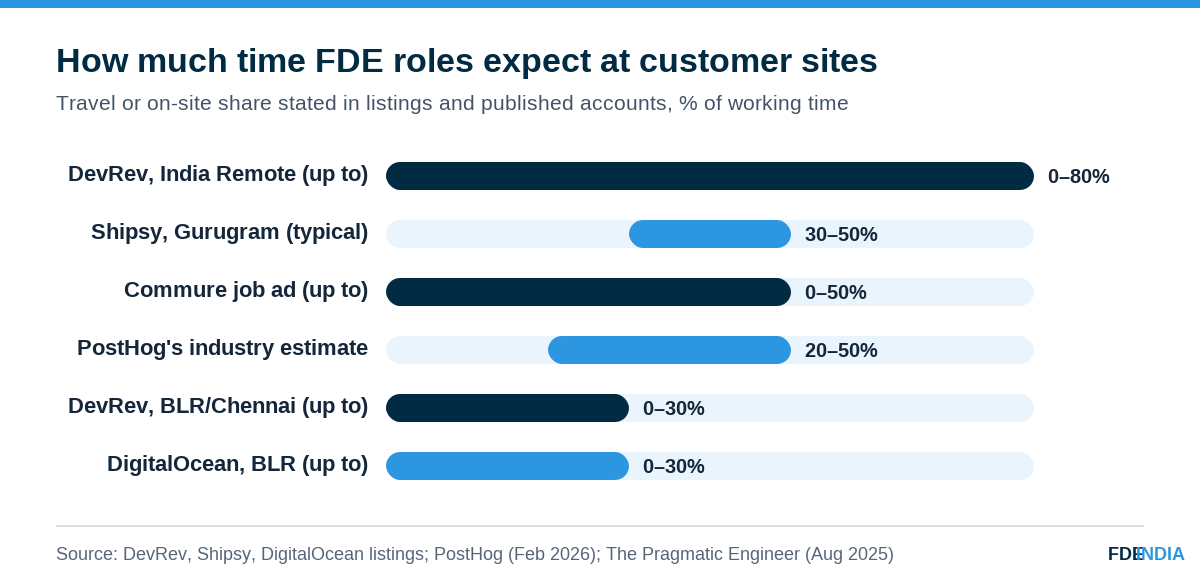 “Remote” in a job title does not mean no travel: DevRev’s India Remote FDE role has the highest stated travel. Data: employer listings checked Nov 2026; PostHog (Feb 2026); The Pragmatic Engineer (Aug 2025).
Note the oddity: DevRev’s India Remote FDE role lists the highest travel figure. “Remote” here appears to mean you are not tied to a DevRev office, not that you stay home. Ask in the first recruiter call. For remote-first options, see FDE jobs open to remote candidates in India.
How an engagement paces your weeks
Days only make sense inside the engagement’s clock. FDE teams time-box their work, and the Insight Partners panel gave three examples of how long they allow before a customer should see production value.
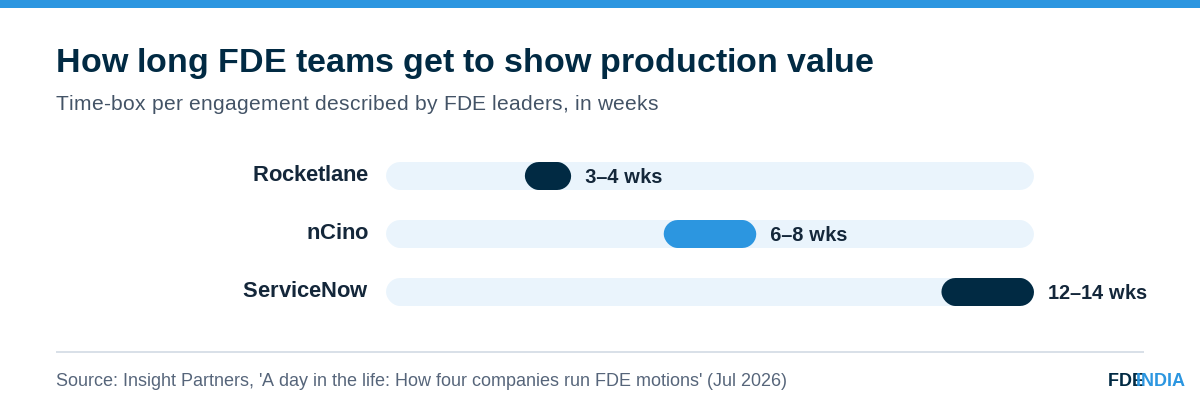 Shorter time-boxes mean more customer days up front and faster go-lives. Data: Insight Partners panel, Jul 2026.
OpenAI’s model, as described in The Pragmatic Engineer, follows a similar rhythm: a couple of days onsite to scope, validation at the customer’s site, then delivery with a few days a week together, while the building itself typically happens at OpenAI’s offices. At ServiceNow, the Insight Partners panel said, work starts with senior customer leaders and uses process mining to find where time is lost, then hands knowledge over to the customer’s developers after the first build.
So a three-week engagement front-loads customer days. A 12-week one gives you long build stretches between check-ins. When you compare offers, the engagement length tells you more about your week than the job title does.
The hard parts, from people who do the job
- Access delays. Getting blocked on site without access is a named bad day on the Insight Partners panel.
- Night-time accountability. Shipsy’s listing is explicit that a 2 am integration failure is yours.
- Time-zone overlap. Some Bengaluru roles serving US customers ask for late-evening availability.
- Burnout. The Insight Partners panel named burnout as the role’s main risk and said it is not solved.
- Context switching. Moving between build, customer and product days in one week is the job, not an exception.
None of these is a reason to avoid the role. They are reasons to ask specific questions before you accept. The FDE vs software engineer comparison covers the trade-offs in pay and growth.
Try the FDE day before you apply: a two-week test
You can test whether this rhythm suits you without changing jobs.
- Volunteer for one customer-facing task. Ask your manager to put you on a customer escalation, onboarding or integration call. Note how you feel after three in one week.
- Run one discovery conversation. Pick an internal team that uses a tool you maintain. Spend 30 minutes watching how they work and write down three problems they did not report.
- Ship one fix for that team within a week. FDEs live on short loops. See whether the pressure energises or drains you.
- Write the feedback memo. Turn what you saw into a half-page note for your product or platform owner: what broke, how often, and a suggested product fix.
- Do one evening debugging session on purpose. Take an on-call shift or join an incident review. Shipsy-style accountability is part of the role.
- Map your travel limit. Decide honestly whether you can do 30%, 50% or 80% travel, then filter listings with that number in mind.
- Turn the two weeks into interview stories. Each step above is a ready answer for the customer and scoping rounds described in our FDE interview process guide.
If the two weeks felt good, the next step is building proof of the skills: our FDE portfolio projects guide maps five builds to what India listings ask for.
Frequently asked questions
What does a forward deployed engineer do every day?
It changes with the stage of the engagement. Some days are mostly coding and fixing bugs, some are spent at the customer site in meetings and workshops, and some go to passing feedback to the product team. Palantir's published description lists meeting customers, building software, configuring products and reporting feedback to product.
How much do forward deployed engineers travel in India?
It depends on the employer. In current listings, DevRev asks for up to 30% travel for its Bengaluru and Chennai FDE role and up to 80% for an India Remote one, and Shipsy expects 30–50% of time at customer sites. A fully remote company like SigNoz lists its FDE role with no travel requirement.
Do FDEs in India work night shifts?
Not as a rule, but some roles serving US customers ask for overlap. A DigitalOcean Bengaluru FDE listing, removed in September 2026, asked for availability until at least noon Eastern Time, which is about 10:30 pm in India in winter. Ask about expected hours in your interview.
Is the FDE job stressful?
It can be. Shipsy's listing says the FDE is accountable when an integration breaks at 2 am, and FDE leaders on an Insight Partners panel named burnout as the role's main unsolved risk. Clear time-boxes and team support make a big difference, so ask how a company runs its engagements.
Where are you right now?
Get a feel for the role and the market first.
- Read next: FDE Hierarchy in India: Career Ladder, Levels, Roles & Pay (2026) →
- See the open FDE roles in India →
Get new FDE jobs and guides every Sunday
One short email a week: new verified FDE roles in India and the week's guides. Unsubscribe in one click.
Check your inbox for a welcome email from [email protected]. Your first FDE Pulse arrives on Sunday.
See where you stand, then close the gaps.
Prepare for the rounds FDE interviews actually test.
Keep going
Sources (8)
- A day in the life: How four companies run FDE motions — Insight Partners, Jul 2026
- What are Forward Deployed Engineers, and why are they so in demand? — The Pragmatic Engineer, Aug 2025
- WTF is a forward deployed engineer? (and why everyone is hiring them) — PostHog, Feb 2026
- Forward Deployed Engineer (Bangalore, Chennai) at DevRev — DevRev on Greenhouse, Nov 2026
- Forward Deployed Engineer (India Remote) at DevRev — DevRev on Greenhouse, Nov 2026
- Forward Deployed Engineer at Shipsy — Shipsy Careers, Nov 2026
- Forward Deployed Engineer (Remote) (India time zones) at SigNoz — Y Combinator Work at a Startup, Nov 2026
- Senior Forward Deployed Engineer I (AI Inference) at DigitalOcean — Built In Bengaluru, Sep 2026

I help engineers move into AI roles that actually pay off. Former software tester and Android developer; I now work with engineers aiming for top product companies, and track FDE hiring in India every week.
LinkedIn profile