

Forward Deployed Engineer KRA at AI Startups in India (2026)
- All seven Bengaluru AI startup FDE listings reviewed make the engineer responsible for getting the customer's system live, not just building a demo.
- Four of the seven (two Sarvam AI roles, Prodigal and Telnyx) name evals or quality metrics as part of the job, and four name production monitoring.
- Experience asks range from 1–3 years at Prodigal to 6+ years for Neuron7's senior role; none of the seven listings posts a salary.
- No listing names a numeric outcome target, so set your own KRA metrics (time to go-live, eval pass rate, incidents) in the first month.
At an AI startup in India, a forward deployed engineer’s main KRA is simple to state and hard to do: get a customer’s AI system live and keep it working. Across seven Bengaluru FDE listings from Sarvam AI, Prodigal, Emergent, Telnyx and Neuron7, every one makes the engineer responsible for go-live, and most add evals, production monitoring and a feedback loop to the product team.
This guide breaks those listings down into the result areas you will actually be judged on, shows how the expectations shift with experience, and gives you a way to set measurable KRAs before your manager does.
How we read the listings
We opened seven forward deployed roles based in Bengaluru, all at AI-first startups and scale-ups, in November 2026. Five were open with apply forms; two Sarvam AI roles on the Khosla Ventures job board were marked as no longer accepting applications, and we include them because they show how one of India’s best-known AI startups defines the job. For each listing we noted which responsibilities are named explicitly. A responsibility counts only if the listing says it, not if it is implied.
| Company | Role | Experience asked | Work mode | Pay posted? |
|---|---|---|---|---|
| Sarvam AI | Forward Deployed Engineer (closed, posted Jul 2026) | 4+ years preferred | Bengaluru | No |
| Sarvam AI | Forward Deployed Software Engineer (closed) | 2–5 years | Bengaluru | No |
| Prodigal | Forward Deployed Engineer – AI Agents | 1–3 years | In-office, Bengaluru | No |
| Emergent | Forward Deployed AI Engineer | 2–5 years (full-stack) | Remote/hybrid, Bengaluru preferred | No (equity mentioned) |
| Emergent | Forward Deployed Engineer (FDE) | Not stated | Bengaluru, night shift for US/Europe | No |
| Telnyx | Forward Deployed Engineer, India | 3+ years | Hybrid, travel across India | No |
| Neuron7 | Senior Forward Deployment Engineer | 6+ years (5+ in Python) | Hybrid, Bengaluru | No (equity mentioned) |
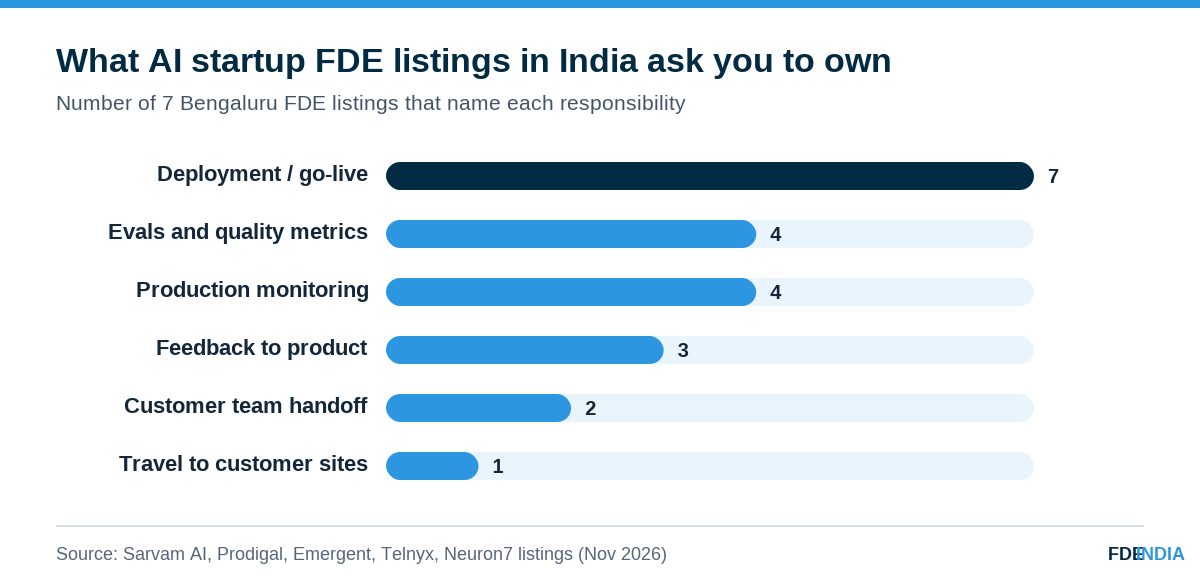 Go-live ownership is universal; evals and monitoring appear in just over half the listings. Tallied from the seven listings above, November 2026.
KRA 1: Own the deployment from scoping to go-live
This is the one result area every listing shares. Sarvam AI’s July 2026 FDE role asked the engineer to own the technical arc of a customer engagement from scoping to production, and to deploy into the customer’s own environment alongside their engineers. Prodigal asks FDEs to own the full lifecycle of AI systems, from scoping and design to deployment, monitoring and iteration, working with Implementation Managers to drive go-lives. Telnyx places its India FDE in a Bengaluru sales pod with an account executive, where the FDE owns discovery, architecture, the proof of concept and the production go-live.
What this means in practice: your work is not “done” when the code merges. It is done when the customer is using it. Telnyx puts it bluntly, asking FDEs to “stay engaged until the solution is live and stable.”
How you’ll be measured: none of the listings names a target, but go-live date versus plan, number of customers live, and the time from kickoff to first production use are the natural metrics for this KRA.
KRA 2: Build evals and prove quality
Four of the seven listings make evaluation an explicit part of the job:
- Sarvam AI (both roles): set up evaluations that measure whether the system works, and define quality metrics for agentic AI systems.
- Prodigal: design and optimise prompts, RAG pipelines and evaluation frameworks for accuracy, latency and reliability.
- Telnyx: build prompt and RAG pipelines and evaluation harnesses for Indic-language use cases, within DPDP and RBI rules.
Emergent’s and Neuron7’s listings do not mention evals; Emergent’s Forward Deployed AI Engineer role instead talks about testing, iterating and working with research on hallucination issues.
At startups selling voice agents, collections agents or Indic-language models, evals are how the customer is convinced the system is good enough to switch on. If you can show an eval set you built, the metric you chose and how it moved, you are speaking the language of these listings. Our guide to FDE skills Indian employers want covers how to build that skill.
KRA 3: Keep it running in production
Four listings name monitoring, observability or production troubleshooting. Telnyx goes furthest: wiring metrics, logs, traces and alerting, setting model routing and fallbacks, writing runbooks, and requiring on-call experience. Neuron7 asks its senior FDE to own reliability and observability across Azure, AWS and GCP, run root-cause analysis on production issues and set up monitoring. Prodigal and Sarvam AI’s software engineer role both include monitoring deployed agents and tuning them from real usage data.
This is where FDE work at an AI startup differs most from a pre-sales or solutions role. You are expected to carry production responsibility for what you shipped. Natural metrics here: incidents per customer, time to resolve, latency and cost per call.
KRA 4: Feed the field back into the product
Three listings ask FDEs to turn what they see at customers into product improvements. Sarvam AI’s FDE role asked engineers to bring field learnings back to product and research. Emergent’s FDE role asks engineers to turn recurring customer problems into product or process improvements, and its AI engineer role describes the FDE as the voice of the customer for the roadmap. Neuron7 adds codifying implementation patterns and mentoring juniors.
Startups hire FDEs partly because their product is still being shaped by customers. Keep a running log of customer issues, the workaround you built and whether it became a product feature. That log becomes your evidence at review time.
KRA 5: Hand over, and sometimes travel
Two listings ask for an explicit handover: Emergent wants FDEs to train customer teams until they are self-sufficient, and Telnyx asks for runbooks and handoff documents. Only Telnyx mentions travel, to customer sites across India. Emergent’s FDE role is also worth noting for its night shift aligned to US and European customers, a working pattern that some India-based FDE roles carry.
How the KRAs change with experience
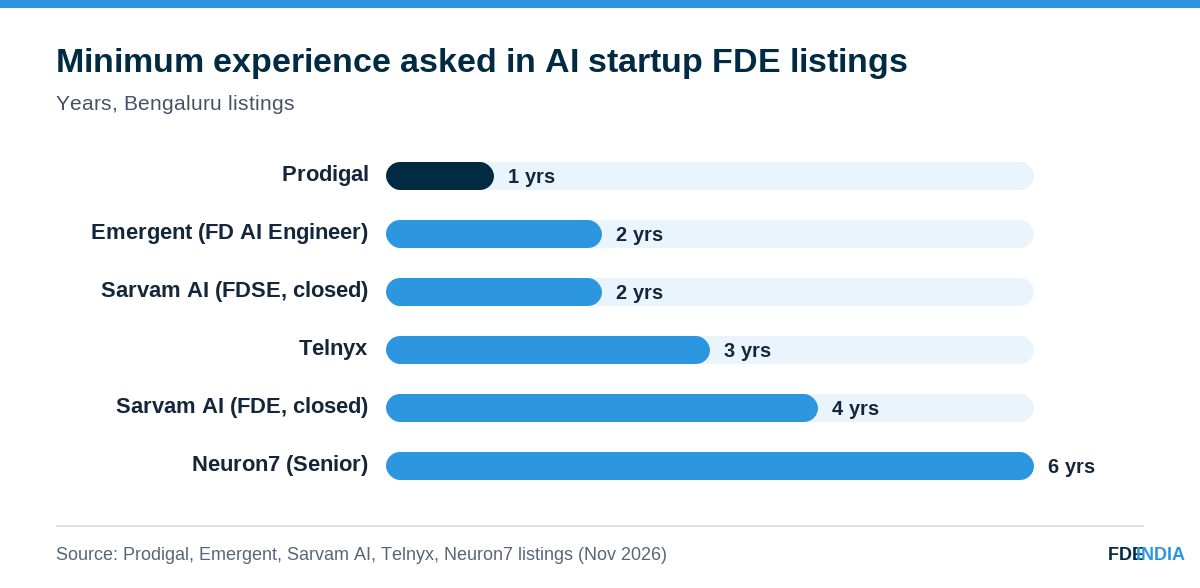 Six of the seven listings state an experience ask; Emergent’s FDE (night shift) role does not. Listings opened November 2026.
The scope grows with the years asked:
- 1–3 years (Prodigal): build and deploy LLM agents, including voice agents, with strong Python and SQL and some exposure to LLMs and RAG. You own your agent’s lifecycle, with Implementation Managers handling much of the customer relationship.
- 2–5 years (Emergent, Sarvam AI’s FDSE role): own client delivery end to end, translate non-technical requirements into working apps or agents, and set up eval pipelines.
- 3–6+ years (Telnyx, Sarvam AI’s FDE role, Neuron7): own architecture and the go-live for a whole account, run infrastructure such as LLM gateways or multi-cloud deployments, carry on-call, and mentor others.
For a fuller view of experience bands across all employer types, see how much experience you need to become an FDE in India.
What the listings don’t say: pay and targets
None of the seven listings posts a salary. Prodigal’s application form asks for pay in LPA without showing a range; Emergent and Neuron7 mention equity without figures. For posted ranges from other FDE listings in India, use the FDE salary hub.
The listings also never name a numeric outcome target. That is normal at startups, where targets are set per customer, but it means you should agree on KRAs early. Read Sarvam AI’s company page at /companies/sarvam-ai/ for more on how it hires.
How to set your own FDE KRAs in the first 30 days
- List your accounts and their go-live dates. Write down each customer you own, the agreed live date and what “live” means (first real user, first 1,000 calls, full rollout).
- Pick one quality metric per deployment. Use what the listings emphasise: eval pass rate, accuracy on a fixed test set, latency or cost per request. Record a baseline before you change anything.
- Set up monitoring before go-live, not after. Alerts, logs and a short runbook for each customer. Track incidents and time to resolve from day one.
- Start a field-feedback log. One line per customer problem: what broke, your fix, and whether it should become a product feature. Share it with product every two weeks.
- Write a handover note for every deployment. What the customer team can run alone, what still needs you, and who to call. This becomes proof of the enablement KRA.
- Review with your manager at day 30. Bring the numbers from steps 1–5 and agree which three will be your formal KRAs for the quarter.
If you are preparing for these roles rather than already in one, the FDE interview process guide shows how startups test for deployment ownership and customer judgment, and the FDE Fit Check can show which of these KRAs your current experience already covers.
Frequently asked questions
What are the KRAs of a forward deployed engineer at an AI startup?
In current Bengaluru listings from Sarvam AI, Prodigal, Emergent, Telnyx and Neuron7, the core KRA is taking a customer from scoping to a live, stable deployment. Most also add building evals, monitoring the system in production and feeding customer problems back to the product team.
Do FDEs at AI startups own evals?
Often, yes. Prodigal asks FDEs to design evaluation frameworks, Telnyx asks for evaluation harnesses for Indic-language use cases, and Sarvam AI's FDE listings asked engineers to set up eval pipelines and quality metrics. Emergent and Neuron7 listings do not mention evals.
How much experience do AI startups want for FDE roles in India?
It varies widely. Prodigal asks 1–3 years, Emergent's Forward Deployed AI Engineer role asks 2–5 years of full-stack work, Telnyx asks 3+ years of shipping production software, and Neuron7's senior FDE role asks 6+ years.
Do AI startup FDE listings in India show salary?
None of the seven listings reviewed for this guide posts a pay range; Neuron7 and Emergent mention equity without figures. Use the FDE India salary hub for posted ranges from other listings.
Where are you right now?
Get a feel for the role and the market first.
- Read next: FDE Roles at GCCs in India: KRAs, Skills and Pay (2026) →
- See the open FDE roles in India →
Get new FDE jobs and guides every Sunday
One short email a week: new verified FDE roles in India and the week's guides. Unsubscribe in one click.
Check your inbox for a welcome email from [email protected]. Your first FDE Pulse arrives on Sunday.
See where you stand, then close the gaps.
Prepare for the rounds FDE interviews actually test.
Keep going
Sources (7)
- Forward Deployed Engineer @ Sarvam AI — Khosla Ventures Job Board, Jul 2026
- Forward Deployed Software Engineer | 2-5 years @ Sarvam AI — Khosla Ventures Job Board, 2026
- Forward Deployed Engineer - AI Agents at Prodigal — Greenhouse, Nov 2026
- Forward Deployed AI Engineer at Emergent — Greenhouse, Nov 2026
- Forward Deployed Engineer (FDE) at Emergent Labs — Greenhouse, Nov 2026
- Forward Deployed Engineer, India at Telnyx — Greenhouse, Nov 2026
- Neuron7 - Senior Forward Deployment Engineer (FDE) (AI/ML | Python) — Lever, Nov 2026

I help engineers move into AI roles that actually pay off. Former software tester and Android developer; I now work with engineers aiming for top product companies, and track FDE hiring in India every week.
LinkedIn profile